
For US builders, developers, architects, and estate owners, windows are no longer a simple commodity purchase. They affect energy performance, building-code compliance, construction timelines, facade appearance, interior comfort, and long-term maintenance costs. When the project involves luxury villas, boutique hotels, apartment developments, or commercial buildings, even one wrong window package can lead to schedule delays, water leakage, failed inspections, and costly rework.
That is why many project owners now explore sourcing custom windows overseas. China remains one of the world’s strongest manufacturing bases for architectural aluminum windows, thermal break systems, large-format glazing, and complete building material packages. However, successful importing is not about finding the lowest factory quote. It is about understanding the real import windows from China, landed cost, verifying compliance before production, and controlling quality from drawings to delivery.
At George Homes, we help builders and project owners reduce sourcing risk through integrated one-stop building material solutions. With 20 years of project experience and a Dedicated Project Manager for each order, we coordinate design review, shop drawings, production, quality inspection, packing, logistics, and after-sales support across complete project categories.
This guide explains how to calculate the true cost, what tariffs and fees to consider in 2026, how to evaluate suppliers, and how to avoid the most common mistakes when importing windows from China to the United States.
Why US Builders Import Windows from China
Importing windows from China can still make sense for many projects, but the reason is not simply “China is cheaper.” The real advantage appears when the project requires customization, multiple material categories, coordinated design, and container-level procurement.
For example, a luxury villa may require thermal break aluminum windows, sliding glass doors, pivot doors, custom cabinetry, stone, tiles, sanitary ware, lighting, and furniture. If each category is sourced separately, the builder must manage multiple vendors, different lead times, inconsistent finishes, separate quality checks, and repeated shipping costs.
A one-stop supplier can consolidate these moving parts into one coordinated procurement schedule. For the right project size, this can reduce communication friction, improve design consistency, and make container utilization more efficient.
Importing is usually most suitable for:
- Custom homes and luxury villas with non-standard window sizes.
- Apartment, hotel, or resort projects with repeated window schedules.
- Builders who need matching doors, windows, cabinets, tiles, stone, and furniture.
- Projects where shop drawings, sample approval, and factory QC can be completed before mass production.
- Buyers who can plan early enough to allow manufacturing, shipping, customs clearance, and inland delivery.
However, importing is not ideal for emergency replacement windows, very small orders, or projects that cannot tolerate international logistics timing.
The Real Question: How much does it cost to import windows from China?
The answer depends on product type, frame material, glass specification, order quantity, Incoterms, freight market conditions, US port, final delivery address, and applicable tariffs. A simple factory quote does not show the real cost.
To answer How much does it cost to import windows from China?, buyers must separate three numbers:
- Factory price — the product cost quoted by the manufacturer.
- Shipping and import cost — freight, insurance, port charges, customs brokerage, duties, and fees.
- Installed project value — whether the imported package actually meets the drawings, code requirements, energy targets, and construction schedule.
The lowest factory quote is not always the lowest project cost. A supplier who does not provide accurate shop drawings, proper packaging, certified glass, or replacement support may create far more cost after the shipment arrives.
Factory Price vs. Landed Cost
When working with an aluminum window manufacturer in China, you will usually see EXW, FOB, CIF, or DDP pricing. These terms change who controls cost and risk.
EXW: Ex Works
EXW means the factory price only. The buyer is responsible for pickup from the factory, export documentation, local trucking, ocean freight, insurance, customs clearance, and inland delivery. This gives maximum control but also requires the most logistics experience.
FOB: Free on Board
FOB is often the most practical term for experienced importers. The supplier handles local transport, export customs, and loading onto the vessel at the Chinese port. The buyer then controls ocean freight, insurance, US customs clearance, and inland trucking.
CIF: Cost, Insurance, and Freight
CIF includes product, ocean freight, and insurance to the destination port. It may look simple, but buyers must still handle customs clearance, duties, port fees, and inland delivery in the United States.
DDP: Delivered Duty Paid
DDP appears convenient because it includes delivery and duty handling, but it requires careful review. For regulated or high-tariff products, buyers should confirm who acts as importer of record, how duties are declared, and whether the quote is compliant. For B2B construction projects, many serious buyers still prefer to work with their own licensed customs broker for transparency.
2026 Landed Cost Formula for Imported Windows
A practical landed cost formula is:
Landed Cost = Product FOB Value + Ocean Freight + Insurance + Customs Duties + Section 301 / Section 232 Duties if applicable + MPF + HMF + Brokerage + Port Charges + Inland Trucking + Contingency
Here is a realistic example for a custom aluminum window package for a luxury residential project.
| Cost Item | Example Estimate | Notes |
|---|---|---|
| Product value | $18,000 FOB | Depends on window type, thermal break profile, glass, hardware, finish, and quantity |
| Ocean freight, 40HQ | $3,500–$5,500 | Varies by route and season; recent Shanghai–LA and Shanghai–NY rates show large route differences |
| Marine insurance | $100–$300 | Often based on cargo value |
| Base customs duty | 5.7% if classified under HTS 7610.10.00 | Final HTS classification must be confirmed by broker |
| MPF | 0.3464%, subject to min/max | CBP fee for formal entries |
| HMF | 0.125% for ocean cargo | Applies at many US ports |
| Section 301 / Section 232 | Case-specific | Can materially change total landed cost |
| Customs broker, bond, ISF | $300–$800+ | Depends on broker and shipment complexity |
| Port / terminal / drayage fees | $500–$1,500+ | Depends on destination port and congestion |
| Inland trucking | $1,000–$3,000+ | Depends on distance from port to job site |
| Contingency | 3%–8% | Covers rate fluctuation, storage, exam, or schedule changes |
For aluminum windows, the tariff section deserves special attention. USITC lists aluminum doors, windows, frames, and thresholds under HTS 7610.10.00 with a 5.7% general duty rate. But in 2026, China-origin aluminum and metal-related products may also be affected by Section 301 and Section 232 measures, depending on the exact product, country of origin, metal content, and Chapter 99 classification. USTR maintains the China Section 301 tariff action and exclusion process, including four-year review updates. CBP also issued 2026 guidance that certain steel, aluminum, copper articles and derivatives may face 10%–50% additional Section 232 duties from April 6, 2026.
Because of this, any article about importing windows should avoid promising a fixed tariff percentage. The correct approach is to request a broker review before order confirmation.
2026 Tariff Reality Check: Do Not Rely on Old Cost Assumptions
Many older online guides still say that importing aluminum windows from China usually involves only a small base duty plus a simple Section 301 surcharge. That is no longer a safe assumption.
In 2026, US import cost planning should include:
- HTS classification review.
- Country-of-origin review.
- Section 301 applicability.
- Section 232 metal tariff review.
- Any active exclusions or temporary extensions.
- MPF and HMF.
- Possible anti-dumping or countervailing duty exposure for certain aluminum products.
- Customs bond and importer-of-record responsibility.
This does not mean importing is always too expensive. It means the buyer must calculate the landed cost before production, not after the container arrives.
George Homes supports this process by preparing product descriptions, material details, packing lists, commercial invoice data, and technical specifications for broker review. Final classification and duty advice should always come from a licensed U.S. Customs broker or qualified trade professional.
When Importing Still Saves Money
Even with higher tariffs, importing windows from China can still be cost-effective in the right scenario. The savings often come from more than the window price itself.
Importing can be attractive when:
- The project uses many custom sizes that are expensive domestically.
- The window package is shipped together with other building materials.
- The design requires premium finishes, slim aluminum profiles, or large glass panels.
- The buyer can approve samples and shop drawings before mass production.
- The supplier provides coordinated packaging, inspection, and replacement support.
- The project has enough volume to fill a container efficiently.
For a single small order, tariffs and logistics may reduce the advantage. For a full villa, hotel, apartment, or commercial project, the combined savings across Doors & Windows, cabinetry, stone, tiles, sanitary ware, lighting, and furniture can still be significant.
How to Evaluate an aluminum window manufacturer in China
Choosing the wrong supplier is the most expensive mistake in international window procurement. A qualified manufacturer should be evaluated on engineering ability, certifications, materials, production control, packaging, and after-sales support.
1. Engineering and Shop Drawing Capability
A serious supplier must be able to read architectural drawings, window schedules, elevation drawings, section details, and opening dimensions. Before production, the supplier should provide detailed shop drawings showing:
- Overall size and rough opening coordination.
- Frame depth and profile series.
- Opening direction.
- Mullion and transom layout.
- Glass thickness and IGU build-up.
- Hardware type and location.
- Drainage path and weep hole design.
- Installation method.
- Color and surface finish.
- Fly screen or security screen details, if required.
This step is especially important for a custom size windows manufacturer. American projects rarely match standard metric sizes exactly, and even a 10 mm error can cause serious installation problems.
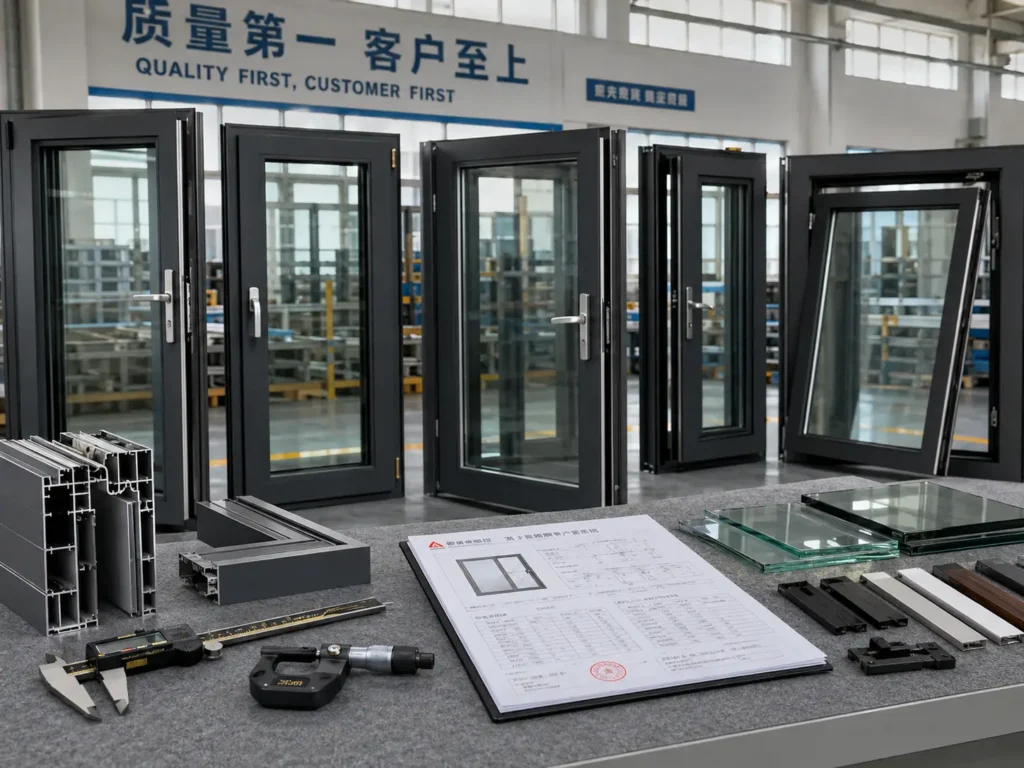
2. Aluminum Profile Quality
For premium projects, aluminum profile quality directly affects structural strength, surface finish, and service life. Ask the supplier to confirm:
- Aluminum alloy grade.
- Profile wall thickness.
- Thermal break strip material.
- Surface treatment standard.
- Powder coating or fluorocarbon coating quality.
- Salt-spray or weathering test data for coastal projects.
- Structural calculation support for high wind-load areas.
For coastal villas or high-rise projects, surface finish should be upgraded. AAMA 2604 or AAMA 2605-level coating performance is often more appropriate than basic powder coating. FGIA describes AAMA 2605 as a specification for superior-performing organic coatings on aluminum extrusions and panels for architectural products.
3. Thermal Break Performance
A basic aluminum frame conducts heat quickly. For US projects, especially in areas with strict energy codes or large glazed openings, a thermal break aluminum windows supplier is usually the better choice.
Thermal break aluminum windows use an insulating barrier, often polyamide, between the interior and exterior aluminum profiles. This reduces heat transfer, improves comfort, and helps reduce condensation risk.
However, do not judge performance by the frame description alone. Ask for full-window performance data. The US Department of Energy explains that NFRC U-factor ratings represent the whole product, including frame and spacer materials, not only the center of glass. This is important because some suppliers may advertise only glass performance, which can make the window look better than it really is.
4. Glass and Safety Certification
Glass is the largest part of most window systems, so it must be specified carefully. Depending on location and code requirements, you may need:
- Tempered glass.
- Laminated safety glass.
- Double or triple insulated glass units.
- Low-E coating.
- Argon gas fill.
- Warm-edge spacers.
- Impact-resistant glazing for hurricane-prone areas.
- SGCC-certified safety glazing for relevant applications.
SGCC provides certification for safety glazing materials, and SGCC-certified products are commonly associated with standards such as ANSI Z97.1 and CPSC 16 CFR 1201. CPSC 16 CFR Part 1201 covers safety requirements for architectural glazing materials used in products such as doors, storm doors, shower doors, and sliding glass doors.
For US projects, builders should confirm local code requirements before production because energy, safety, impact, and egress requirements vary by state, city, building type, and installation location.
Energy Ratings: U-Factor, SHGC, VT, and Air Leakage
Energy performance is one of the most important parts of window selection. The main ratings include:
U-Factor
U-factor measures how much non-solar heat flows through the window. Lower U-factor means better insulation. For cold climates, low U-factor is especially important.
SHGC
Solar Heat Gain Coefficient measures how much solar heat enters through the window. Lower SHGC helps reduce cooling load in hot climates, while higher SHGC may be useful in some colder climates where winter solar gain is desired. DOE notes that the right SHGC depends on climate, orientation, and shading conditions.
VT
Visible Transmittance measures how much visible daylight passes through the glass. Higher VT means more natural light, but it should be balanced with glare control and solar heat gain.
Air Leakage
Air leakage measures air movement through and around the window assembly. A low air leakage number indicates a tighter product, but proper installation is still essential.
For serious projects, do not accept vague claims like “energy-saving glass.” Ask for tested or simulated values based on recognized methods and confirm whether the values apply to the full window assembly.

Quality Control Checklist Before Mass Production
A professional procurement process should not wait until the goods arrive in the United States. Most problems should be prevented before the container is loaded.
Before production, confirm:
- Final shop drawings signed by the buyer.
- Glass specification confirmed.
- Frame color sample approved.
- Hardware sample or brand confirmed.
- Screen and accessories confirmed.
- Installation method reviewed.
- Packing method confirmed.
- Spare glass or spare hardware policy confirmed.
- Production schedule confirmed.
During production, check:
- Aluminum profile thickness.
- Corner crimping and joint sealing.
- Drainage holes.
- Gasket installation.
- Glass thickness and Low-E orientation.
- Hardware operation.
- Lock alignment.
- Surface finish defects.
- Dimension tolerance.
- Labeling by room or window number.
Before shipment, inspect:
- Random finished units.
- Full opening and locking test.
- Glass surface defects.
- Packing strength.
- Label accuracy.
- Packing list consistency.
- Container loading photos.
- A-frame or crate stability.
George Homes coordinates this process through your Dedicated Project Manager, helping reduce communication gaps between design, factory production, inspection, and delivery.
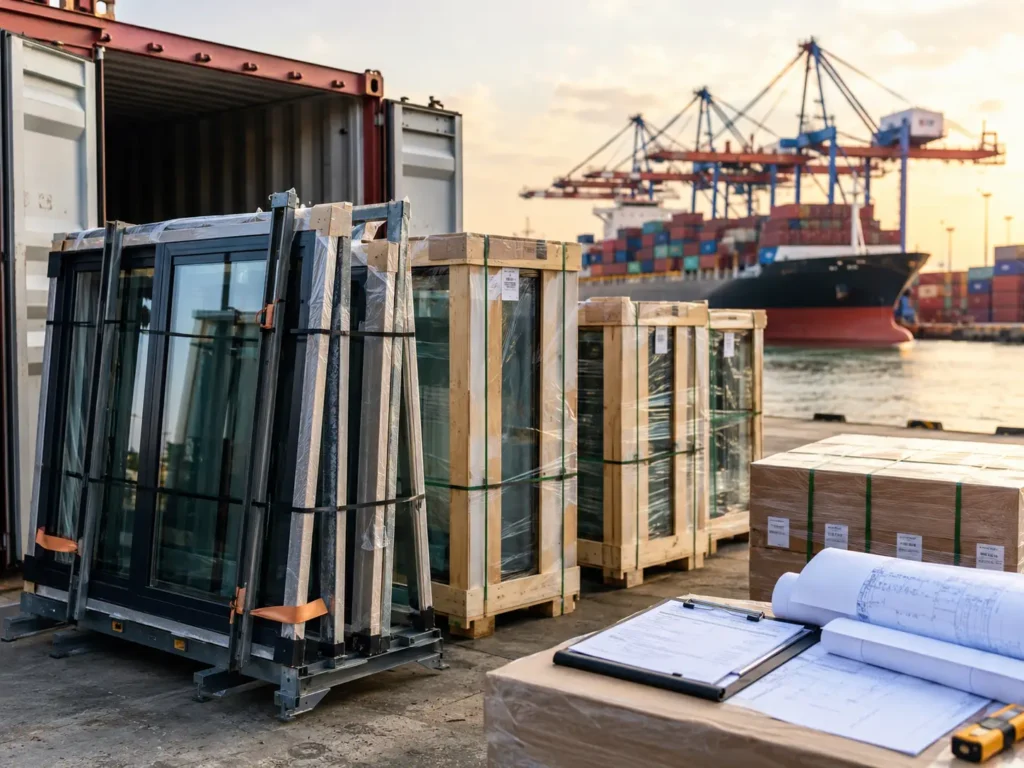
Packaging: The Hidden Factor That Protects Your Investment
Windows are heavy, fragile, and expensive to replace after international shipping. Poor packaging can destroy the savings of importing.
For large glass panels and custom window systems, request:
- Steel A-frame racks for large glass.
- Fumigated wooden crates or plywood crates where required.
- Corner protection.
- Foam and moisture barrier protection.
- Vertical glass loading.
- Clear window number labels.
- Container loading photos.
- Packing list matched to the window schedule.
- Extra protection for hardware and exposed finishes.
For one-stop project shipments, George Homes can coordinate window packaging with other materials such as Marble & Granite, Tile, sanitary ware, and furniture to reduce container damage and improve unloading efficiency.
Lead Time: What Builders Should Expect
A realistic timeline for importing custom windows from China is usually 8 to 14 weeks, depending on project complexity and shipping conditions.
Typical timeline:
| Stage | Estimated Time |
|---|---|
| Drawing review and quotation | 3–7 days |
| Shop drawings and revisions | 1–3 weeks |
| Sample / color confirmation | 1–2 weeks |
| Production | 4–7 weeks |
| Factory inspection and packing | 3–7 days |
| Ocean freight | 2–5 weeks depending on port |
| Customs clearance and inland delivery | 1–2 weeks |
Complex projects, hurricane-impact requirements, special finishes, oversized glass, or multi-category one-stop orders may require more time. The safest approach is to start window procurement before rough openings are finalized, not after the building envelope is already waiting.
One-Stop Sourcing: Why It Matters for Whole-Project Cost
If you only import windows, you solve one category. If you coordinate windows with all visible materials, you solve the project.
George Homes provides one-stop building material solutions for builders, developers, and private estate owners who want consistent quality across multiple categories. Instead of managing separate suppliers for windows, cabinets, stone, tiles, bathrooms, lighting, and furniture, you can coordinate the full package through one team.
A complete procurement package may include:
- Doors & Windows
- Kitchen & Wardrobe
- Sanitary
- Flooring & Staircase
- Lighting
- Furniture Collection
- Marble & Granite
- Tile
This matters because windows interact with many other finishes. Window frame color should match facade materials. Sill details should coordinate with stone. Door and window hardware should match interior hardware. Cabinet and flooring tones should not conflict with window finishes. By planning all categories together, the project becomes more predictable.

Common Mistakes When Importing Windows from China
Mistake 1: Comparing FOB Price Only
FOB price is not landed cost. Always include freight, duties, MPF, HMF, brokerage, port fees, inland delivery, and contingency.
Mistake 2: Ignoring Tariff Updates
Tariffs change. A quote from last year may not reflect current Section 301 or Section 232 exposure. Always confirm with a broker before placing an order.
Mistake 3: Accepting Glass-Only Energy Data
Center-of-glass data is not the same as full-window data. Ask whether U-factor and SHGC apply to the complete window assembly.
Mistake 4: Skipping Shop Drawings
Never approve production based only on a quotation. Shop drawings prevent size, direction, hardware, drainage, and installation mistakes.
Mistake 5: Using Weak Packaging
International glass shipping requires professional packaging. A few hundred dollars saved on packing can cause thousands of dollars in damage.
Mistake 6: Waiting Too Long
Custom windows affect the building envelope. Late window procurement can delay waterproofing, interior finishes, and occupancy schedules.
FAQ
Yes, for the right project. It is most worthwhile for custom homes, villas, hotels, apartments, and commercial projects with enough volume to justify international logistics. However, because tariffs can materially affect cost, buyers should calculate landed cost before production.
FOB is often the most balanced option for experienced importers because the supplier handles China-side export and loading, while the buyer controls ocean freight, insurance, customs clearance, and inland delivery. CIF or DDP can work, but the buyer should confirm all hidden costs and compliance responsibilities.
They can, but only if specified correctly. Buyers should confirm glass safety requirements, energy ratings, wind-load needs, egress rules, and local code requirements before production. NFRC, SGCC, CPSC, and project-specific engineering requirements may be relevant depending on the project.
Most custom projects require 8 to 14 weeks from drawing confirmation to US delivery. Complex projects may take longer, especially if special coatings, oversized glass, impact-resistant glazing, or multi-category material consolidation is required.
Final Recommendation: Calculate Before You Commit
Importing windows from China can reduce cost, expand customization options, and simplify sourcing for large projects. But the process must be handled professionally. In 2026, the biggest risk is not the factory price. The biggest risk is making decisions without a complete landed cost, verified specifications, and a clear quality-control plan.
George Homes helps builders and developers turn complex overseas sourcing into a controlled project workflow. From window shop drawings to full-material coordination, your Dedicated Project Manager helps align design, production, inspection, packaging, and delivery.
Ready to get an exact landed cost calculation for your architectural plans? Click the WhatsApp button in the bottom right corner of your screen to contact George Homes for a detailed project quotation.
Authority References
- U.S. International Trade Commission: HTS 7610.10.00 aluminum doors, windows, frames, and thresholds; 5.7% general duty rate. (关税协调表)
- U.S. Customs and Border Protection: 2026 Section 232 guidance on certain steel, aluminum, copper articles and derivatives. (GovDelivery)
- USTR: China Section 301 tariff actions and exclusion process. (United States Trade Representative)
- U.S. Department of Energy: NFRC labels, U-factor, SHGC, air leakage, and whole-window performance explanation. (The Department of Energy’s Energy.gov)
- Safety Glazing Certification Council: SGCC safety glazing certification. (SGCC)
- CPSC / eCFR: 16 CFR Part 1201 safety standard for architectural glazing materials. (电子联邦法规)
- Drewry World Container Index: 2026 transpacific freight-rate reference. (德鲁里)