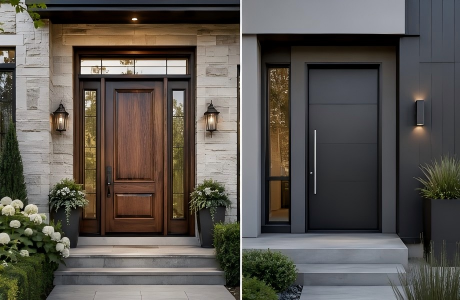
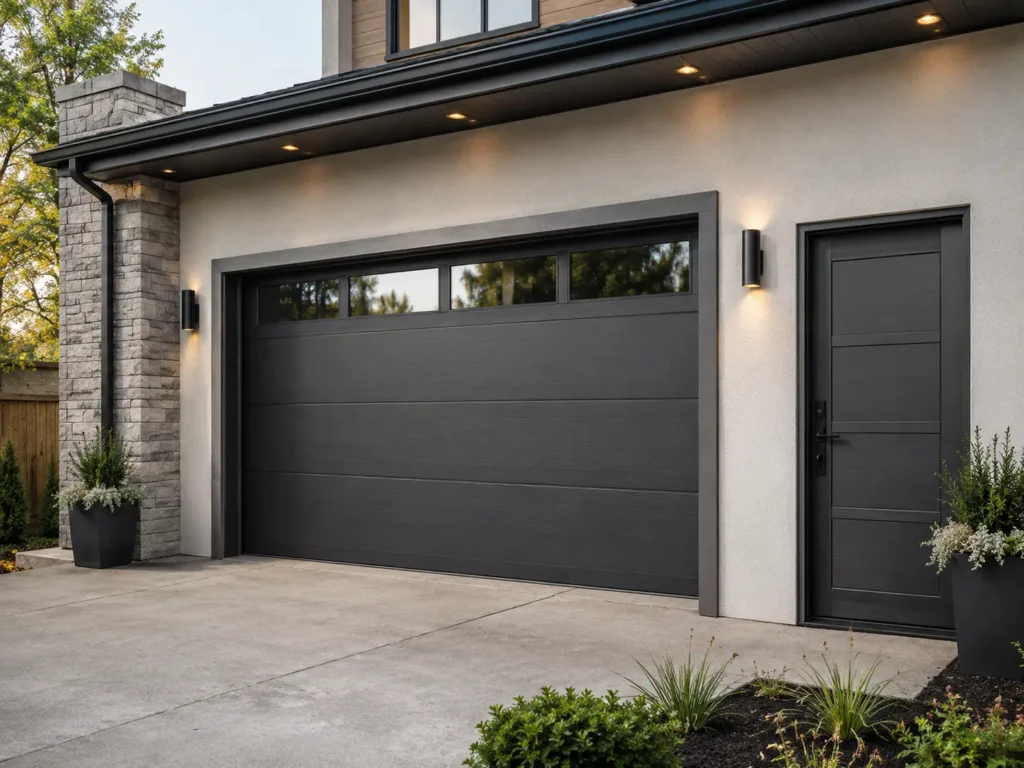
A garage personnel door is a standard pedestrian entrance that allows people to enter or leave a garage without opening the main vehicle door. It may be installed in an exterior garage wall, between an attached garage and another part of a building, or directly within a larger garage door.
For frequently used garages, workshops, service buildings, and high-end residential properties, a dedicated personnel door can improve everyday access, privacy, security, and climate control.
However, choosing one involves more than selecting a door style. The material, frame, locking system, insulation, threshold, installation method, and local building requirements must all suit the intended application.
This article explains the main garage personnel door configurations, their practical benefits, and the specifications buyers should review before placing an order.
What Is a Garage Personnel Door?
A garage personnel door is designed for people rather than vehicles. It is also commonly called a:
- Garage side door
- Pedestrian garage door
- Garage access door
- Side-hinged garage door
- Pass door
- Wicket door
These terms are sometimes used interchangeably, but they can describe different door configurations.
External Garage Side Door
An external side door is installed in a separate opening in the garage wall. It provides direct access from a driveway, garden, service area, warehouse yard, or other outdoor space.
This is generally the most practical configuration because it operates independently from the main garage door. It can also be designed to coordinate with the building’s entrance doors, windows, cladding, and garage-door finish.
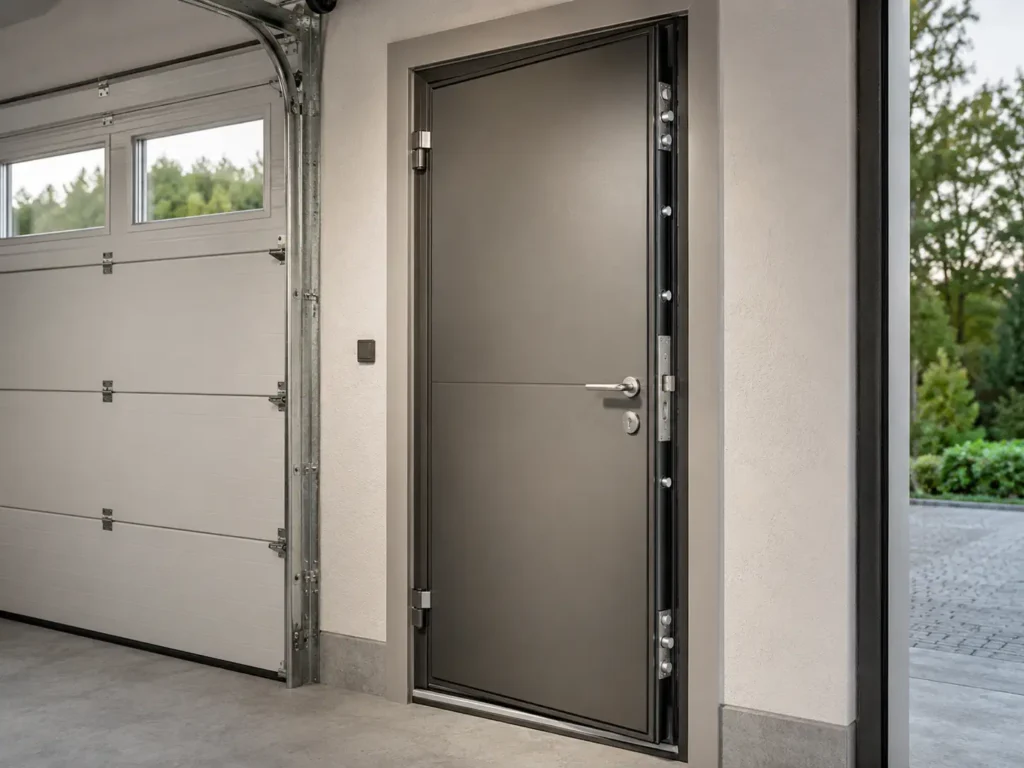
Garage-to-Building Connecting Door
This type of door connects an attached garage with a house, corridor, utility room, office, workshop, or another occupied area.
It should not automatically be specified as an ordinary interior or exterior door. Depending on the location and applicable code, the opening may require particular fire-separation, closing, latching, smoke-control, or construction features.
For example, the International Residential Code includes specific requirements for openings and separations between attached garages and dwelling units.
Integrated Wicket Door
A wicket door, sometimes called an integrated pass door, is built directly into a sectional, folding, or industrial garage door.
It provides pedestrian access where there is not enough wall space for a separate side entrance. However, this configuration can introduce:
- A raised bottom threshold
- Additional seals and moving parts
- More complex installation and adjustment
- Restrictions on automatic garage-door operation
- Potential accessibility or trip-hazard concerns
Before selecting a wicket door, the project team should confirm the required clear opening, threshold height, control system, structural design, and local safety requirements.
Why Install a Separate Garage Personnel Door?
Not every garage requires a pedestrian entrance. However, it can provide clear advantages in frequently accessed or climate-controlled spaces.
Faster and More Convenient Access
A personnel door allows occupants to enter without waiting for a large overhead door to open.
This is useful for garages that also function as:
- Workshops
- Bicycle storage areas
- Utility spaces
- Equipment rooms
- Commercial service areas
- Maintenance facilities
- Inventory storage rooms
Because the door can be manually operated, it may also provide access during a power outage, depending on the lock configuration.
Greater Privacy
Opening a full-width garage door exposes vehicles, equipment, stored materials, and interior activity to people outside the property.
A smaller pedestrian entrance limits visibility and allows occupants to enter without revealing the entire garage interior.
This is particularly valuable for luxury residences, commercial facilities, and properties containing high-value tools or vehicles.
Reduced Operation of the Main Garage Door
Garage-door springs, rollers, tracks, hinges, seals, and motorized operators experience wear through repeated operating cycles.
Using a pedestrian door for routine foot traffic can reduce unnecessary use of the main garage door. The actual maintenance benefit will depend on the frequency of use, product quality, installation, and maintenance schedule.
Better Control of Indoor Conditions
Opening a large garage door creates a substantial exchange of indoor and outdoor air. In a heated, cooled, or humidity-controlled garage, this can make it harder to maintain stable conditions.
A smaller, correctly sealed door reduces the size of the opening used for routine entry.
The U.S. Department of Energy notes that exterior doors can contribute to energy loss through both heat conduction and air leakage, especially when they are uninsulated, poorly installed, or inadequately sealed.
The final result depends on the complete assembly, including:
- Door leaf
- Frame
- Insulated core
- Perimeter seals
- Threshold
- Glazing
- Installation joints
- Hardware adjustment
An insulated door leaf alone cannot compensate for large gaps around the frame or threshold.
When Is a Garage Personnel Door Most Useful?
A dedicated personnel entrance is worth considering when:
- The garage is accessed several times each day.
- Occupants regularly enter without a vehicle.
- The main garage door is particularly large or slow.
- Valuable vehicles, tools, or stock are stored inside.
- The space is heated, cooled, or humidity-controlled.
- The garage doubles as a workshop or utility room.
- Employees require controlled access.
- Smart locks or access-control systems are needed.
- Opening the main door would create privacy concerns.
For a small detached garage that is rarely used, the cost of creating a separate opening may not provide the same practical benefit.
Garage Personnel Door Materials Compared
The best door material depends on the required security, climate, architectural style, maintenance level, and budget.
| Material | Main Advantages | Important Considerations | Typical Applications |
|---|---|---|---|
| Steel | High strength, durable, compatible with commercial hardware | Requires suitable corrosion protection and coating maintenance | Commercial garages, workshops, high-security projects |
| Aluminum | Corrosion-resistant, lightweight, modern appearance | Thermally broken profiles may be needed in conditioned spaces | Coastal projects, contemporary villas |
| Composite or Fiberglass | Low maintenance, moisture-resistant, available in wood-look finishes | Reinforcement and product quality vary by manufacturer | Residential garages, humid climates |
| Timber | Natural appearance, highly customizable | Requires moisture protection and regular maintenance | Luxury villas, traditional architecture |
Steel Garage Personnel Doors
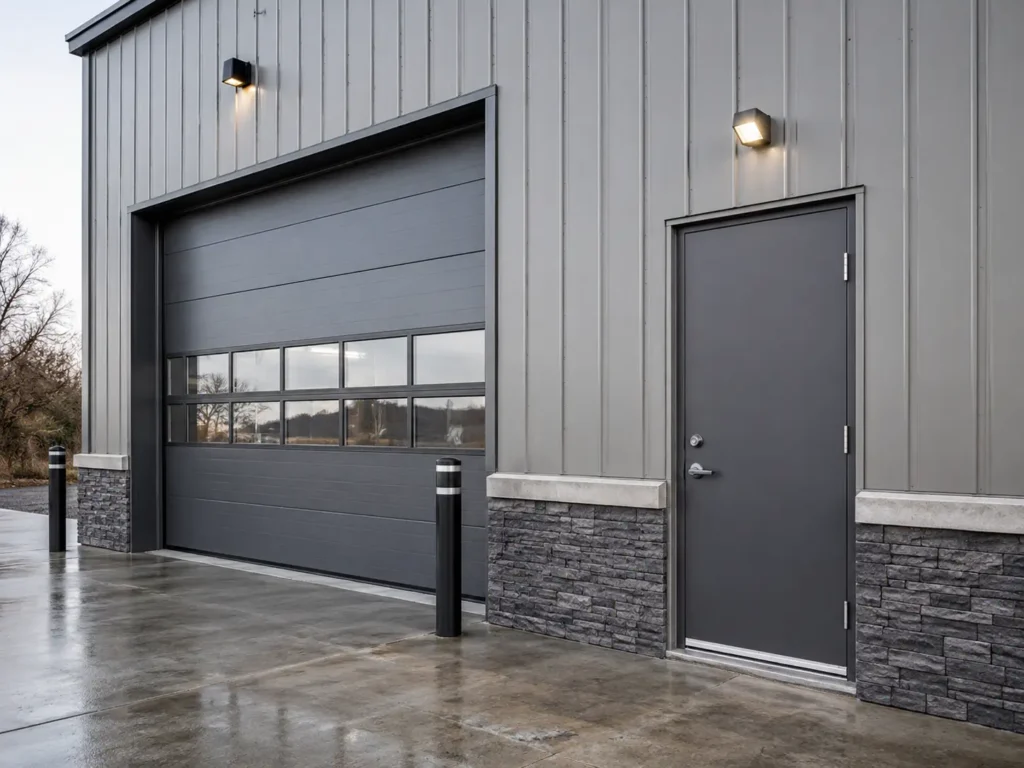
Steel is commonly selected for commercial and security-focused applications because it offers good structural strength and can accommodate heavy-duty locking and closing hardware.
A typical steel assembly may include:
- Insulated or honeycomb door core
- Galvanized or galvannealed surfaces
- Reinforced lock and hinge locations
- Steel door frame
- Factory-applied coating
- Weather seals
- Adjustable threshold
However, describing a product as a “steel door” does not establish its performance.
The buyer should also confirm:
- Door-face thickness
- Internal core
- Frame construction
- Lock reinforcement
- Hinge reinforcement
- Coating system
- Corrosion protection
- Tested performance
- Applicable certifications
ANSI/SDI A250.8 covers the sizes, materials, construction, design, and finishing of standard steel doors and frames. The Steel Door Institute also states that these specifications must be coordinated with applicable building and fire-code requirements.
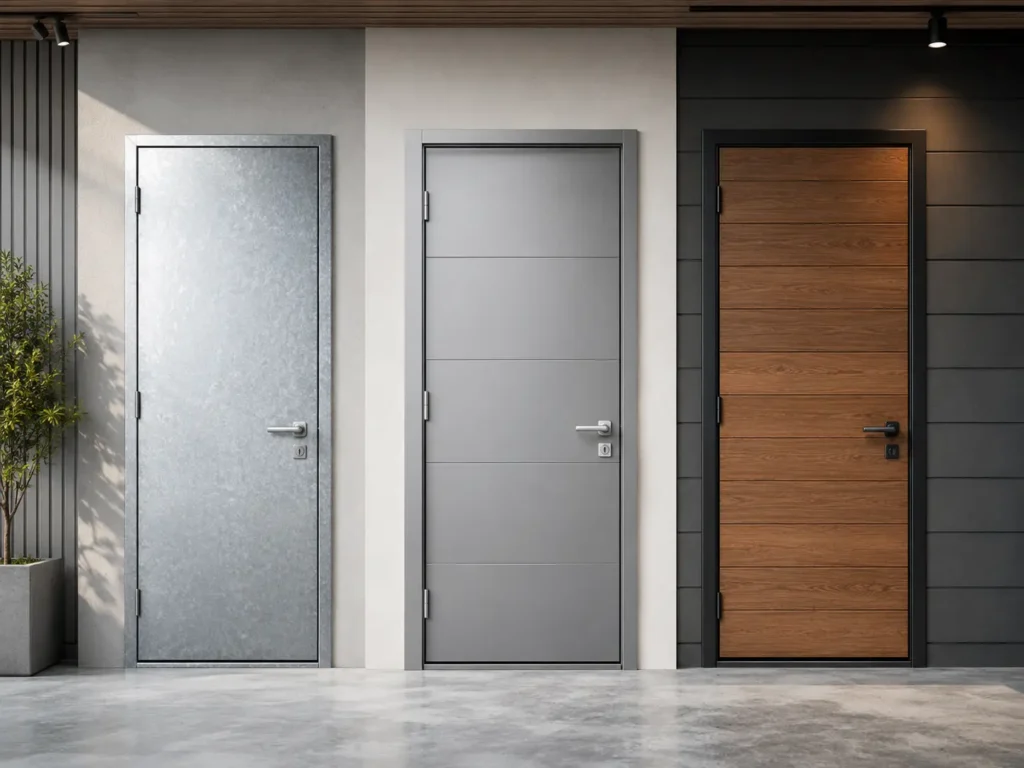
Aluminum Garage Personnel Doors
Aluminum works well with contemporary architecture and is especially useful in locations where corrosion resistance is important.
For conditioned garages, buyers should consider a thermally broken or thermally improved aluminum system. Standard metal frames can transfer heat unless their profiles are designed to reduce thermal bridging.
In coastal or humid environments, confirm the suitability of:
- Frame finish
- Hardware
- Fasteners
- Sealants
- Threshold
- Adjacent metals
A corrosion-resistant frame will not prevent premature deterioration if incompatible fasteners or unsuitable hardware are used.
Composite and Fiberglass Doors
Composite and fiberglass doors generally require less maintenance than natural timber. They can also provide good resistance to humidity and moisture.
Some products reproduce the appearance of wood while reducing the risk of warping or decay.
Before specification, confirm:
- Internal reinforcement
- Core construction
- Surface finish
- Edge sealing
- Lock preparation
- Maximum available size
- Exterior-use warranty
Timber Garage Personnel Doors
Timber is often selected for luxury villas, traditional residences, and projects where the garage entrance must coordinate with natural doors, cladding, or other architectural elements.
Its visual quality depends heavily on material selection and finishing. Moisture exposure, sunlight, drainage, and maintenance frequency should be considered before choosing solid wood.
Correct sealing of the top, bottom, faces, and edges is essential for long-term dimensional stability.
Security Features That Require Attention
Security should be assessed across the entire opening rather than by looking at the lock alone.
A high-security lock installed in a weak frame or poorly anchored wall will provide limited protection.
Reinforced Door and Frame Construction
The door frame should suit the wall construction and be anchored correctly.
Where heavy-duty locks, closers, hinges, or access-control hardware are used, the relevant areas of the door and frame may need additional reinforcement.
For projects with elevated security requirements, ask for tested forced-entry performance instead of relying only on descriptions such as “secure,” “reinforced,” or “heavy duty.”
Suitable Locking Hardware
Available locking options include:
- Single-point deadlocks
- Multi-point locking systems
- Commercial mortise locks
- Keypad locks
- Card-reader systems
- Electronic access-control locks
- Panic or emergency-exit hardware
Multi-point locks secure the door at several locations and can improve compression against the weather seals. They are often suitable for residential and external commercial applications.
However, a multi-point locking system is not automatically suitable for every emergency exit. Doors located on an egress route may need hardware that allows occupants to leave quickly and without specialist knowledge.
The final hardware arrangement should be checked against the occupancy type and local safety requirements.
Hinge-Side Protection
Outward-opening doors may have externally exposed hinges.
Possible security measures include:
- Non-removable hinge pins
- Security studs
- Hinge bolts
- Concealed hinges
- Reinforced hinge plates
These features help prevent the door from being removed or forced open from the hinge side.
Secure Glazing
Glazing can improve daylight and visibility, but it may also affect privacy, security, insulation, and fire performance.
Depending on the project, suitable options may include:
- Laminated security glass
- Insulating glass units
- Obscure or frosted glass
- Fire-rated glazing
- Narrow vision panels
- Internal blinds
Buyers should specify the complete glazing assembly rather than only the nominal glass thickness.
Thermal and Weather Performance
For conditioned garages and workshops, measurable performance is more useful than general claims such as “energy efficient.”
Important specifications may include:
- Door U-factor or thermal transmittance
- Air-leakage rating
- Core material and thickness
- Thermally broken frame
- Insulating glass
- Continuous perimeter gasketing
- Bottom seal
- Threshold design
- Drainage details
- Installation-joint sealing
- Wind and rain resistance
The U.S. Department of Energy explains that a lower air-leakage rating indicates a tighter door or window assembly, while actual performance also depends on correct installation.
Steel Door Institute technical documents also provide recommendations for gasketing, thresholds, hardware schedules, and frame anchoring for standard steel doors.
Fire Safety and Building Requirements
The required door specification depends heavily on its location.
An external door from a detached garage may have different requirements from a door separating an attached garage from a dwelling, hotel corridor, office, or other occupied space.
Potential considerations include:
- Fire-resistance rating
- Labeled door and frame assembly
- Self-closing hardware
- Self-latching hardware
- Smoke or draft control
- Door opening direction
- Emergency egress
- Panic hardware
- Clear opening width
- Accessible threshold
- Opening force
- Glazing restrictions
- Distance from a property boundary
Where a fire rating is required, installing a rated door leaf in an ordinary frame does not necessarily create a compliant assembly.
The door, frame, seals, glazing, hardware, labels, wall construction, and installation must be coordinated as a complete system.
The adopted requirements should be confirmed with the project architect, fire consultant, contractor, building official, or other qualified local professional.
Can a Garage Personnel Door Be Retrofitted?
A personnel door can often be added to an existing garage, but the work may involve more than cutting an opening and installing a frame.
Before construction begins, inspect:
- Whether the wall is load-bearing
- Whether it contributes to structural bracing
- Required lintel or header support
- Electrical cables and plumbing
- Exterior drainage
- Ground and finished-floor levels
- Flashing and waterproofing
- Available door-swing space
- Fire-separation requirements
- Planning and building approvals
The installer should also confirm the wall thickness, frame depth, door handing, opening size, threshold level, and required clear passage.
Incorrect structural preparation or water management can lead to cracking, leaks, corrosion, or premature door failure.
Is Planning Permission Required?
Planning and approval requirements vary by country, region, building type, and property status.
In England, the Planning Portal states that adding doors of a similar appearance to the existing house will not usually require planning permission. However, Article 4 Directions, listed-building status, leasehold restrictions, local policies, and other conditions may change the requirements.[6]
Building regulations may still apply even when planning permission is not required.
The safest wording for an international article is therefore:
A garage side door may not require formal planning permission in some locations, but structural work, fire separation, energy performance, safety glazing, property restrictions, and local building regulations may still apply. Always confirm the requirements with the relevant local authority before construction.
What Determines the Cost?
There is no universal price for a garage personnel door because quotations often include different products and services.
The total cost can be influenced by:
- Door and frame material
- Standard or custom dimensions
- Insulated core
- Security or fire rating
- Locking hardware
- Access-control preparation
- Door closer
- Panic hardware
- Glazing
- Finish and color
- Coastal coating
- Structural alterations
- Installation
- Freight and taxes
- Order quantity
- Site conditions
A low unit price may exclude the frame, threshold, seals, hardware, glazing, packaging, or installation accessories.
For an accurate B2B quotation, provide:
- Opening dimensions
- Wall construction
- Door handing
- Required quantity
- Hardware requirements
- Performance requirements
- Finish reference
- Delivery destination
- Project schedule
Why Work With George Homes?
Large residential and commercial projects frequently require doors, windows, cabinetry, flooring, staircases, and architectural finishes to follow one coordinated design language.
George Homes provides One-Stop Building Project Solutions for residential, hospitality, and commercial projects.
Instead of coordinating unrelated manufacturers individually, clients can integrate their Doors & Windows, Kitchen & Wardrobe, and Flooring & Staircase requirements through one project workflow.
With more than 20 years of industry experience, our services can include:
- Product selection support
- Material and finish coordination
- Shop-drawing review
- Sample confirmation
- Production follow-up
- Quality inspection
- Packaging coordination
- Global logistics support
Each project is supported by a Dedicated Project Manager, providing a consistent point of contact from the initial project requirements through manufacturing and shipment.
Final technical performance and compliance should always be confirmed against the approved drawings, destination-market regulations, and product-specific documentation.
Frequently Asked Questions
Yes. A professional contractor can cut into existing brickwork or modify the current garage structure to install a side-hinged personnel door, provided there is sufficient structural support.
Yes, regarding security and maintenance. Steel doors offer superior resistance to forced entry and require very little upkeep, whereas wooden doors provide premium aesthetics but require regular sealing and treatment.
No, typically you do not need planning permission to add a personnel door to an existing garage, as it usually falls under permitted development. However, always verify with local building authorities for heritage or conservation areas.
Costs vary widely based on material and security ratings. A basic steel personnel door may start around $500, while high-security, thermally broken commercial doors with multi-point locks can range from $1,200 to $3,000+.
Conclusion
A correctly specified garage personnel door can improve pedestrian access, privacy, security, and environmental control without requiring routine operation of the main garage door.
However, the door should be treated as a complete installed system. The material, frame, locks, hinges, seals, threshold, glazing, structural support, and installation method must work together.
For builders, contractors, developers, and homeowners sourcing residential or commercial garage side doors, George Homes can coordinate the door specification with the wider building-material package.
Contact your Dedicated Project Manager through the WhatsApp chat icon or [reach out to us here] with your drawings, dimensions, quantities, and delivery destination. Our team can prepare a project-specific recommendation and quotation.
Clients are also welcome to visit our offline showroom to compare materials, finishes, hardware, and coordinated building solutions in person.
Technical note: This article provides general product and specification information. Final selection and installation must comply with the codes, approvals, and professional requirements applicable to the project location.
References
- U.S. Department of Energy — Doors
- International Code Council — 2024 International Residential Code, Chapter 3: Building Planning
- Steel Door Institute — ANSI/SDI A250.8: Specifications for Standard Steel Doors and Frames