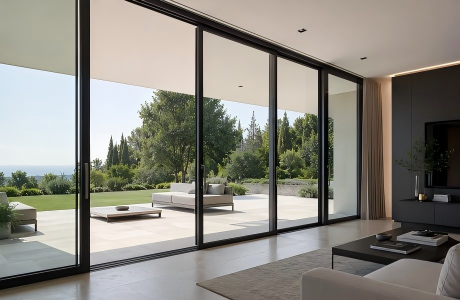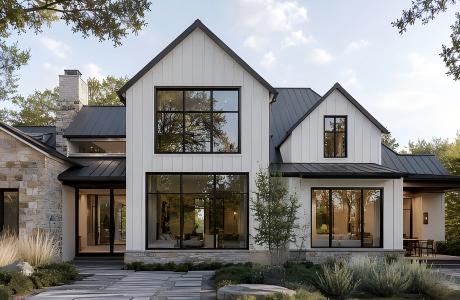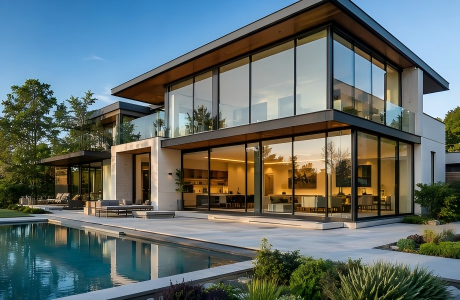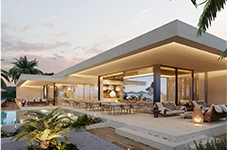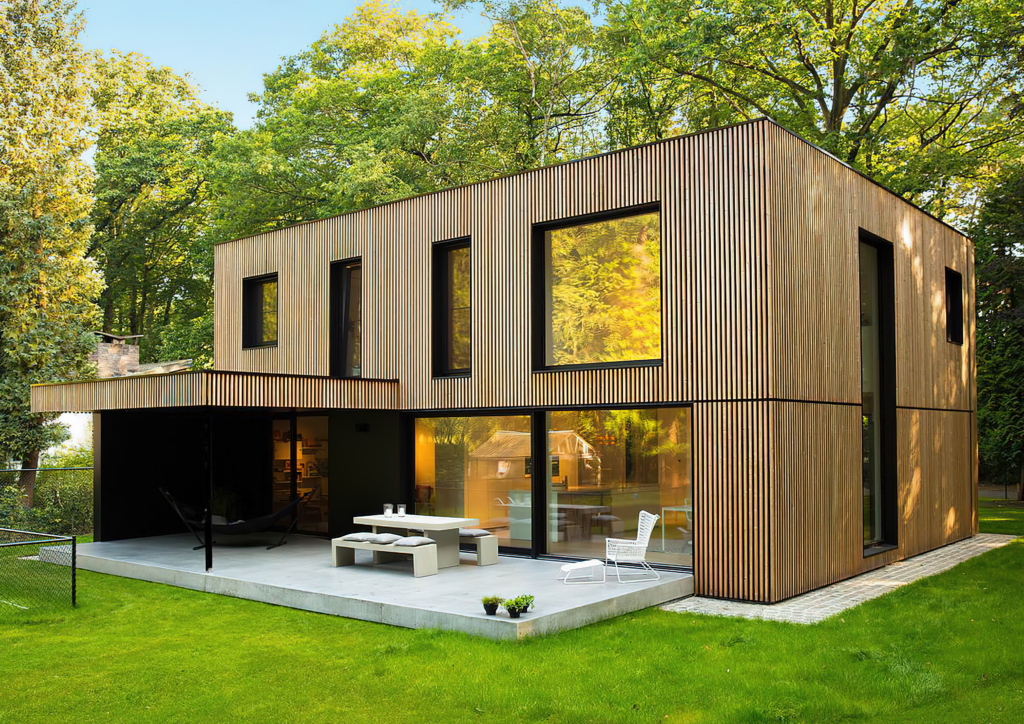
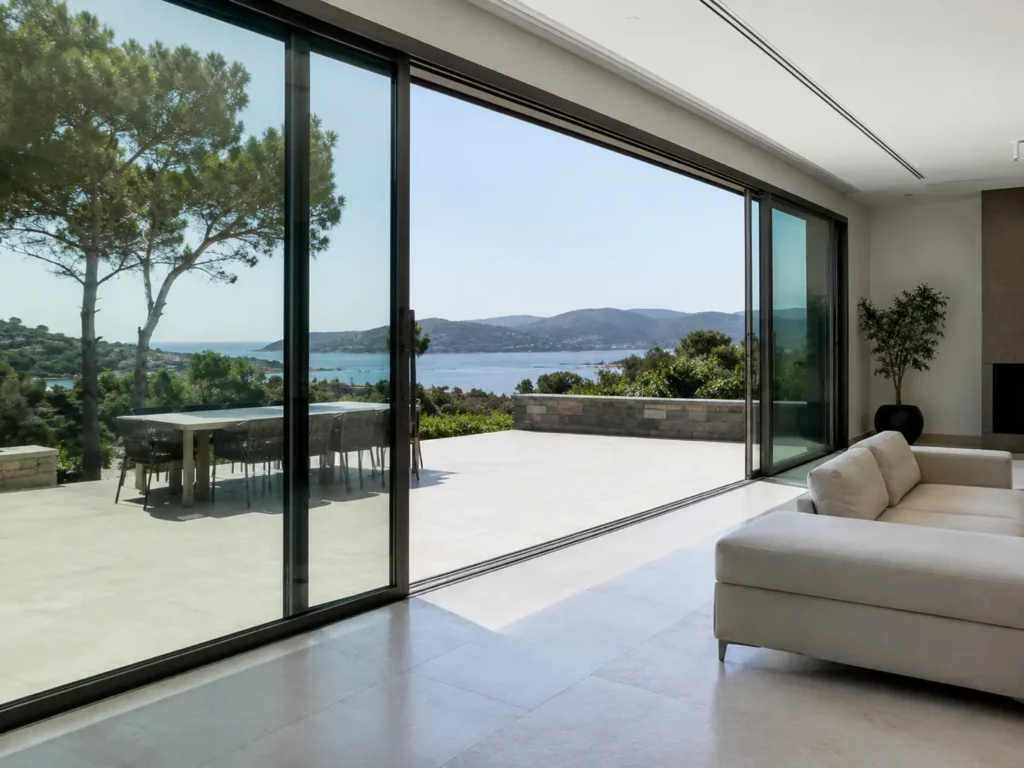
Quick Answer: What Is a Large Opening Door?
A large opening door is an oversized architectural door system designed to create a wide, seamless connection between indoor and outdoor spaces. Unlike standard patio doors, these systems use reinforced aluminum profiles, heavy-duty rollers or hinges, insulated glass units, precision drainage, and project-specific engineering to support wider spans, taller panels, and heavier glass.
For luxury villas, resorts, hotels, commercial clubhouses, and high-end residential developments, large opening doors are not just decorative features. They affect structural performance, natural light, ventilation, thermal comfort, weather resistance, security, and the overall value of the building.
The best system depends on the project goal:
- Choose multi-slide or lift-and-slide doors for panoramic views and very wide openings.
- Choose bifold doors when the priority is a nearly full clear opening.
- Choose pivot doors for dramatic entrance statements and large single-panel design.
- Choose a one-stop supplier when door systems must match flooring, stairs, cabinetry, stone, lighting, and furniture finishes across the whole project.
Why Large Opening Door Systems Matter in Modern Architecture
Contemporary architecture increasingly focuses on open-plan living, visual continuity, and indoor-outdoor connection. In this design language, walls are no longer simply barriers. They become flexible transitions between living rooms, terraces, gardens, pools, courtyards, and hospitality spaces.
That is why large exterior door systems are widely used in:
- Luxury villas and private residences
- Resort suites and beachfront hotels
- Commercial clubhouses
- Restaurants and outdoor dining spaces
- High-end apartments and penthouses
- Golf villas and vacation properties
- Real estate showrooms and sales centers
However, the larger the door opening becomes, the more demanding the engineering becomes. A wide glass door must resist wind pressure, water infiltration, frame deflection, heat transfer, air leakage, and long-term operational wear. Choosing the wrong system can lead to difficult sliding operation, water leakage, glass vibration, poor insulation, delayed installation, and expensive on-site rework.
For builders, architects, developers, and overseas project managers, selecting the right large opening door system is both a design decision and a risk-control decision.
What Makes a Door System “Architectural Grade”?
Not every wide patio door should be considered an architectural door system. For high-end projects, the system should be evaluated by structure, performance, hardware, finish, and installation support.
An architectural-grade large opening door usually includes:
- Reinforced aluminum or thermally broken aluminum profiles
- Large-format insulated glass units
- Heavy-duty rollers, hinges, or pivot hardware
- Multi-point locking systems
- Engineered drainage and sill design
- Powder-coated or anodized surface finish
- Wind-load and water-resistance considerations
- Shop drawings and project-specific technical review
- Custom sizing and finish coordination
A standard residential patio door may work for small openings. But for oversized panels, coastal environments, commercial usage, and luxury projects, a custom architectural door system is usually the safer and more reliable choice.
Top Types of Large Opening Door Systems
Multi-Slide and Lift-and-Slide Door Systems
Multi-slide doors use multiple glass panels that slide along two, three, or more tracks. Depending on the design, panels can stack to one side, split from the center, or disappear into wall pockets.
For large, heavy panels, Lift-and-Slide systems are often preferred. When the handle is turned, the panel lifts slightly from the track, reducing friction and making the door easier to move. When closed, the panel lowers back down to compress the seals and improve weather resistance.
Best for:
- Luxury living rooms
- Ocean-view villas
- Resort suites
- Large balconies and terraces
- Projects requiring panoramic glass views
Advantages:
- Excellent for very wide openings
- Smooth operation for larger panels
- Strong visual connection to outdoor areas
- Can be designed with pocket openings
- Suitable for high-end residential and commercial applications
Considerations:
- Requires precise track installation
- Needs accurate structural opening dimensions
- Pocket systems require early coordination with wall construction
- Drainage must be carefully designed for exterior use
For projects where the view is the main selling point, lift-and-slide doors usually provide the best balance of scale, comfort, and premium appearance.
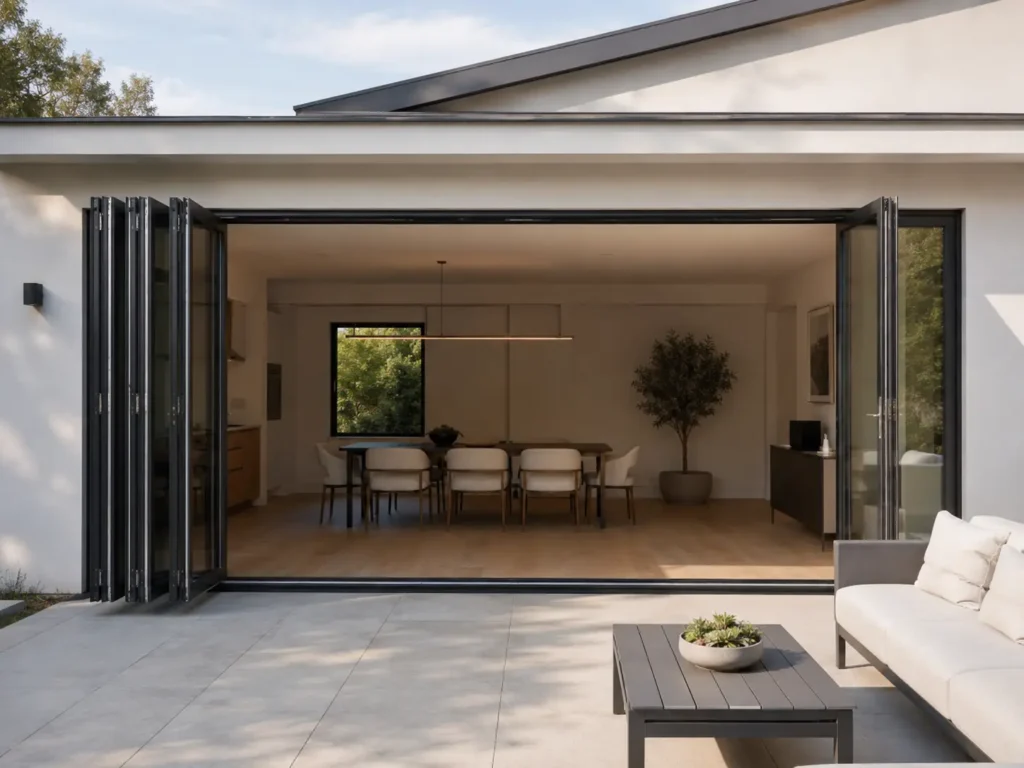
Architectural Bifold Door Systems
Bifold doors, also called folding doors, use multiple connected panels that fold and stack to one or both sides of the opening. When fully open, they can create a much wider clear opening than standard sliding doors.
Best for:
- Indoor-outdoor dining areas
- Poolside lounges
- Restaurant terraces
- Garden-facing living spaces
- Entertainment rooms
Advantages:
- Creates a wide, open passage
- Flexible panel configurations
- Good for social and hospitality spaces
- Allows strong natural ventilation
- Can open partially or fully depending on usage
Considerations:
- Requires stacking space
- Panel alignment is very important
- Top-hung systems require strong structural headers
- Bottom tracks must be protected from dirt and debris
- Not always ideal for extremely windy exposed sites unless properly engineered
Bifold systems are especially useful when the project goal is not just a view, but a physical opening that connects two spaces for movement, dining, entertaining, or commercial use.
Monumental Pivot Doors
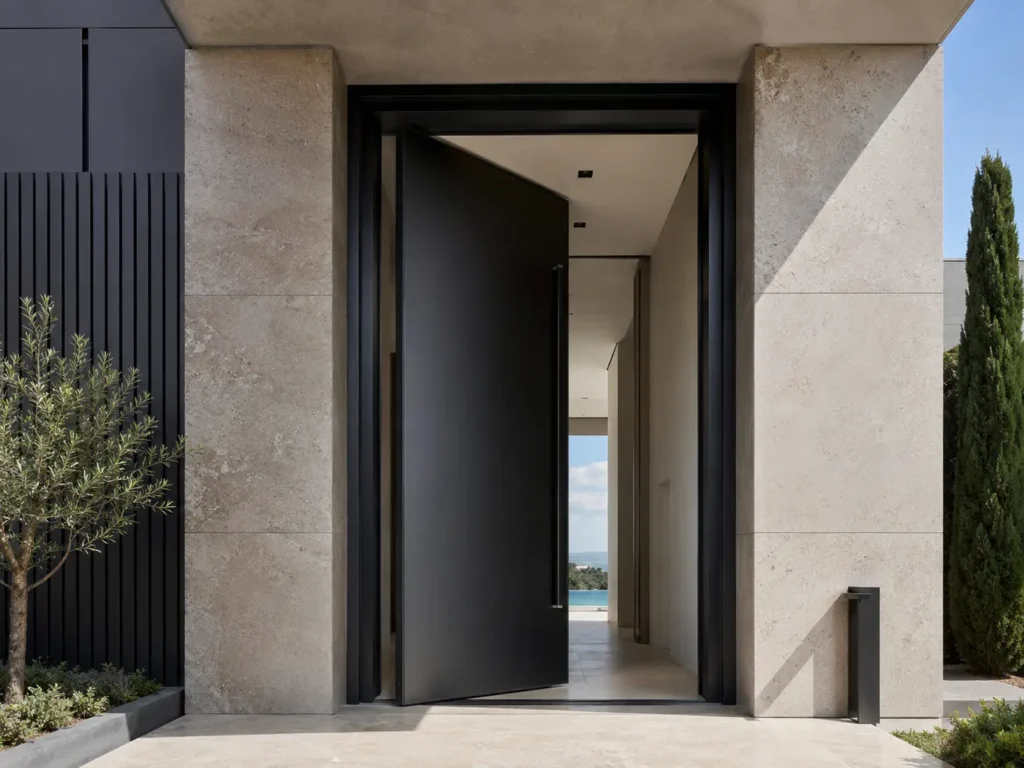
Pivot doors rotate on a pivot point at the top and bottom of the door instead of traditional side hinges. This allows the door panel to be wider and taller, creating a bold entrance statement.
Best for:
- Main villa entrances
- Hotel lobby entrances
- Clubhouse doors
- Luxury residential entryways
- Minimalist architectural facades
Advantages:
- Strong visual impact
- Suitable for oversized entrance design
- Clean and modern appearance
- Can be designed with aluminum, glass, wood veneer, or mixed materials
- Works well with luxury architectural concepts
Considerations:
- The pivot position reduces the actual clear opening
- Heavy panels require high-quality pivot hardware
- Threshold and weather sealing must be carefully detailed
- Not every pivot door is suitable for exposed exterior weather conditions
- Installation tolerance is critical
Pivot doors are ideal when the entrance itself needs to become a design feature. For weather-exposed exterior use, the hardware, seals, drainage, and panel structure should be reviewed carefully before production.
Large Opening Door System Comparison
| System Type | Best Use Case | Main Advantage | Key Consideration |
|---|---|---|---|
| Lift-and-Slide | Villas, resorts, large terraces, ocean-view spaces | Premium operation and panoramic views | Requires accurate track and drainage installation |
| Multi-Slide Door | Wide glass openings and flexible panel stacking | Large opening potential | Track layout must be planned early |
| Bifold Door | Dining areas, patios, entertainment spaces | Creates a very wide clear opening | Needs side stacking space |
| Pivot Door | Main entrances and statement facades | Strong luxury visual impact | Weather sealing and hardware quality are critical |
| Pocket Sliding Door | High-end projects needing hidden panels | Cleanest open-wall effect | Requires early wall and structural coordination |
Key Performance Metrics Buyers Should Check
A beautiful door is not enough. For a large opening door system, performance data is what protects the project after installation.
Wind Load and Structural Strength
Large glass panels face high wind pressure, especially in coastal, high-rise, desert, or storm-prone areas. The larger the glass area, the more important structural calculation becomes.
Before ordering, confirm:
- Project location and local wind-load requirements
- Door height and width
- Glass thickness and laminated glass options
- Mullion and interlock strength
- Frame reinforcement requirements
- Hardware load capacity
- Installation method and fixing details
For exposed projects, do not select the door system only by appearance. The supplier should review drawings and recommend a system based on structural conditions.
U-Factor and Thermal Insulation
U-Factor measures how well a window or door assembly limits heat transfer. A lower U-Factor generally means better insulation. For large glass openings, this is important because glass can make up most of the door area.
To improve thermal performance, consider:
- Thermally broken aluminum profiles
- Double or triple insulated glass units
- Low-E glass coatings
- Argon-filled glass cavities
- Warm-edge spacers
- Proper frame-to-wall insulation
For luxury homes, hotels, and commercial buildings, better insulation improves comfort and can help reduce heating and cooling loads.
SHGC and Solar Heat Control
Solar Heat Gain Coefficient, or SHGC, measures how much solar heat passes through the glass. The right SHGC depends on the climate and building orientation.
For hot climates, west-facing glass, and tropical resorts, lower SHGC glass can help reduce overheating. For colder climates, a different glass specification may be more suitable to capture beneficial solar heat.
This is why large opening doors should not use one generic glass specification for every project. The best glass package should be selected according to climate, direction, building use, and local energy requirements.
Water Penetration and Drainage
Water leakage is one of the most common risks for oversized exterior doors. A flush threshold looks clean, but it must be supported by a proper drainage strategy.
Check whether the system includes:
- Sloped sill design
- Concealed drainage channels
- Sub-sill drainage
- Weep holes
- Waterproof membranes
- Correct exterior floor slope
- Sealant and flashing details
- Installation instructions for wet areas
For exterior applications, especially balconies, pool areas, and coastal villas, drainage should be discussed before production instead of being solved after installation.
Air Leakage and Weather Sealing
Air leakage affects comfort, energy performance, sound insulation, and dust control. Large doors require stable sealing pressure along the frame, interlocks, bottom track, and meeting stiles.
Important details include:
- EPDM or high-quality weatherstripping
- Multi-point locking
- Compression seals
- Interlocking profiles
- Accurate panel alignment
- Proper installation tolerance
A large door that looks impressive but does not seal properly may create drafts, noise, condensation, and long-term customer complaints.
Glass Safety and Security
For large doors, glass selection is a safety issue as well as a design issue. Depending on project location and building code requirements, tempered glass, laminated glass, or laminated insulated glass may be required.
For high-end projects, consider:
- Tempered safety glass
- Laminated glass for impact resistance
- Security laminated glass
- Acoustic laminated glass
- Low-E laminated insulated glass
- Multi-point locks
- Reinforced frames
- Anti-lift sliding hardware
If the project is in a hurricane-prone or high-wind region, impact-rated glass and certified system testing may be necessary.
How to Choose the Right Large Opening Door for Your Project
Choose Lift-and-Slide Doors If You Want the Best View
If the project needs wide glass, smooth operation, and luxury appearance, lift-and-slide doors are often the strongest option. They are ideal for living rooms, terraces, resort suites, and ocean-view projects.
Choose Bifold Doors If You Want the Widest Clear Opening
If the project needs the indoor and outdoor spaces to become one open area, bifold doors are a practical choice. They are especially useful for hospitality, dining, and entertainment spaces.
Choose Pivot Doors If You Want a Luxury Entrance Statement
If the goal is a dramatic main entrance, a pivot door can create a strong architectural impression. It works especially well for villas, clubhouses, and modern commercial facades.
Choose a Coordinated One-Stop Solution If You Need Finish Consistency
For luxury and commercial projects, the door system should not be selected separately from other materials. The frame color, glass tone, hardware finish, flooring transition, staircase design, stone texture, cabinetry, lighting, and furniture should work together.
This is where George Homes’ one-stop project approach becomes valuable.
Design Integration: Making Large Doors Work With the Whole Interior
A large opening door is not an isolated product. It becomes part of the full building experience.
The aluminum finish should coordinate with Custom Doors & Windows Solutions across the property. The threshold should transition naturally into Flooring & Staircase materials so that indoor and outdoor surfaces feel connected. Large glass openings bring more daylight into the room, highlighting the texture of Marble & Granite, the finish of Kitchen & Wardrobe cabinetry, and the surface details of Tile and Sanitary areas.
At night, glass reflection becomes another design issue. Proper Lighting design helps reduce glare, frame the outdoor view, and create a warmer atmosphere. The scale and placement of the Furniture Collection also need to match the door opening, so the room feels balanced instead of empty or oversized.
When all these materials are sourced separately, color mismatch and design inconsistency are common. A coordinated supply chain helps reduce these risks.
What to Prepare Before Requesting a Quote
To get an accurate quotation for large opening doors, prepare the following information:
- Project location and climate
- Door opening width and height
- Floor plan or elevation drawings
- Preferred system type: sliding, lift-and-slide, bifold, pivot, or pocket
- Indoor or exterior application
- Wind-load or building code requirements if available
- Glass preference: double glazing, triple glazing, Low-E, laminated, acoustic, or impact glass
- Frame color and surface finish
- Hardware color and lock requirements
- Threshold preference: standard sill, low sill, or flush sill
- Quantity and delivery schedule
- Installation support requirements
The more complete the information is, the more accurate the technical recommendation and quotation will be.
Common Mistakes to Avoid When Buying Large Opening Doors
Mistake 1: Choosing Only by Appearance
Large doors need engineering. A slim frame may look beautiful, but it still needs enough strength for wind pressure, glass weight, and daily operation.
Mistake 2: Ignoring Drainage
A flush track without proper drainage can create serious water leakage problems. Always check sill design before confirming the order.
Mistake 3: Using the Same Glass for Every Climate
Hot, cold, coastal, high-altitude, and high-noise locations need different glass specifications. Glass should be selected based on performance, not only price.
Mistake 4: Forgetting the Wall Pocket or Stacking Space
Pocket sliding and bifold systems need enough hidden space or side stacking space. These details must be confirmed during the design stage.
Mistake 5: Separating Door Procurement From Interior Material Planning
If doors, flooring, stone, cabinetry, lighting, and furniture are purchased from different suppliers without coordination, the final project may suffer from color mismatch, inconsistent quality, and installation delays.
Why Top Builders Choose George Homes for Large Opening Door Systems
George Homes supports developers, builders, designers, and overseas project owners with integrated building material and furniture solutions. Instead of sourcing doors, flooring, cabinets, stone, sanitary ware, lighting, and furniture from separate factories, clients can coordinate the full project through one experienced team.
One-Stop Building Material and Furniture Solution
As a one-stop supplier, George Homes helps align door systems with interior and exterior design materials. This is especially important for luxury villas, resorts, apartments, hotels, and commercial developments where consistency matters.
From architectural doors and windows to flooring, staircases, cabinetry, marble, tiles, sanitary products, lighting, and furniture, the goal is to make the entire project look unified and professionally finished.
Custom Engineering Support
Large opening doors often require custom dimensions, technical drawings, glass selection, profile recommendations, and installation coordination. George Homes can support project teams with product selection, drawing review, material matching, and production coordination.
Dedicated Project Manager
Every project needs clear communication. With a Dedicated Project Manager, clients can reduce misunderstandings during specification, quotation, production, delivery, and installation preparation.
Your project manager can help coordinate:
- Door and window specifications
- Drawing review
- Material and finish matching
- Production schedule
- Packing and shipping details
- Project documentation
- After-sales communication
Large Opening Door Buying Checklist
Before confirming your supplier, ask these questions:
- Can the system support my required opening size?
- Is the profile thermally broken?
- What glass options are available for my climate?
- What are the U-Factor and SHGC values?
- How is water drainage handled?
- Is the system suitable for exterior use?
- What hardware brand or hardware grade is used?
- Can the finish match my other doors, windows, and interior materials?
- Are shop drawings provided before production?
- How will the doors be packed for international shipping?
- What installation guidance is available?
- Can the supplier coordinate other project materials at the same time?
If a supplier cannot answer these questions clearly, the project risk may be higher than the initial price difference suggests.
FAQ: Large Opening Door Systems
Yes, multi-slide and lift-and-slide doors can essentially span unlimited widths. By adding additional tracks and panels, or by utilizing a pocketing system where doors disappear into the wall, custom systems can easily cover spans of 40 to 50 feet or more.
Yes, modern architectural sliding doors are highly energy efficient. When engineered with thermal breaks, triple-pane glass, argon gas fills, and Low-E coatings, they meet stringent global energy codes and prevent significant heat transfer despite their massive size.
Lift-and-slide doors utilize specialized hardware that physically lifts the heavy door panel off the track to operate friction-free. Standard sliding doors rely on sheer force to drag the rollers across the track, which limits their maximum weight and size potential.
Yes. Architectural doors designed for coastal environments feature laminated impact glass, structural aluminum reinforcement, and high-DP (Design Pressure) ratings. They are rigorously tested to withstand heavy debris impact and extreme wind loads without catastrophic failure.
Authoritative References
- National Fenestration Rating Council (NFRC) — Official guidance on U-Factor, SHGC, air leakage, and window and door energy-performance ratings.
- U.S. Department of Energy — Explanation of energy-performance ratings for windows, doors, and skylights.
- International Building Code, Chapter 24 — Requirements for glass safety, structural design, and glazing applications.
- FGIA North American Fenestration Standard — Performance requirements for windows, doors, and skylights, including air, water, and structural testing.
Applicable standards and building-code requirements may vary by project location. Final specifications should be confirmed according to local regulations and project engineering requirements.
Build a Better Opening With George Homes
A large opening door can completely change how a building looks, feels, and performs. But the right result requires more than a beautiful glass panel. It requires the right system type, structural review, glass specification, drainage design, installation planning, and finish coordination.
George Homes helps global clients simplify this process with custom architectural door systems and one-stop building material solutions.
Ready to choose the right large opening door system for your next villa, resort, hotel, or commercial project? Click the WhatsApp icon in the bottom right corner to speak with your Dedicated Project Manager, send your project drawings, and receive a customized quotation.