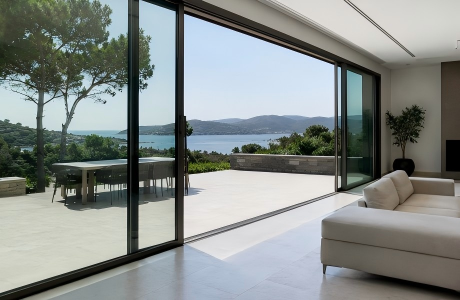
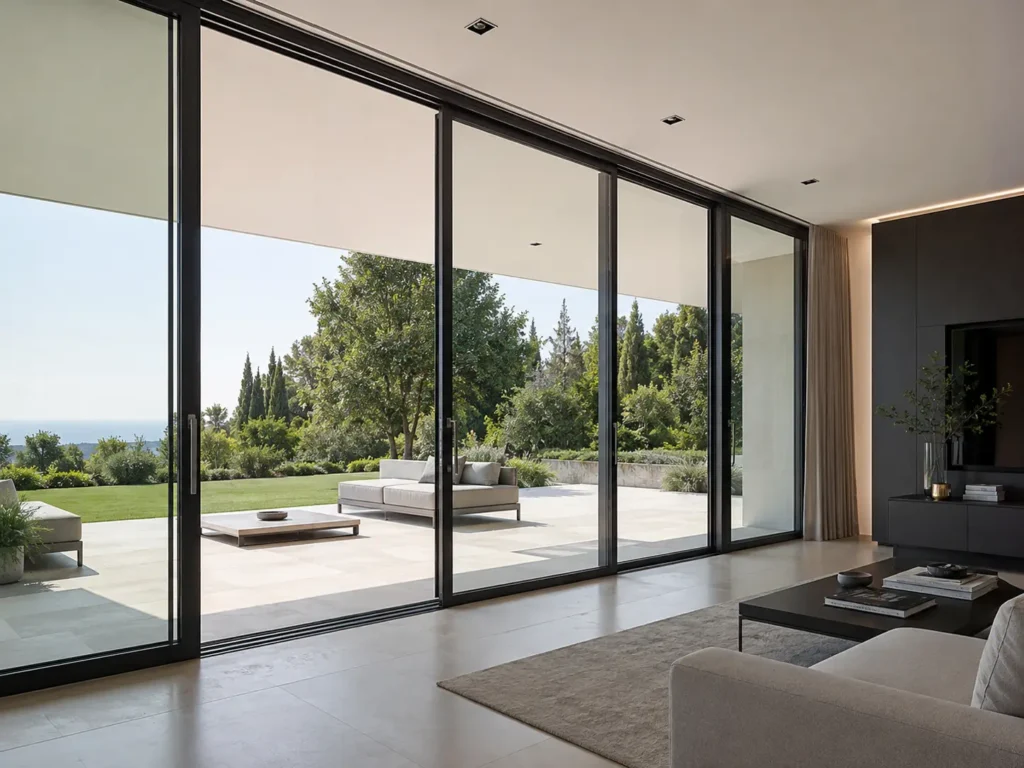
Quick Answer: What Is a Lift and Slide Door?
A lift and slide door is a heavy-duty sliding glass door system designed for large openings and oversized glass panels. When the handle is operated, specialized hardware slightly raises the movable panel away from its compression seals. The panel then rolls along the track with substantially less resistance.
When the door is closed, the panel lowers back onto the seals and engages its locking points. This combination of smooth operation and compression sealing is what distinguishes a lift and slide system from many conventional sliding patio doors.
For architects, villa developers, contractors, and procurement teams, lift and slide doors are most valuable when a project requires:
- Large areas of uninterrupted glass
- Smooth operation despite substantial panel weight
- Strong air and water resistance
- Slim architectural sightlines
- A low or accessible threshold
- A seamless connection between indoor and outdoor spaces
However, performance varies significantly between systems. Panel size, weight capacity, energy efficiency, drainage, security, and accessibility should always be verified through project-specific drawings and test documentation.
Lift and Slide Doors at a Glance
| Question | Practical Answer |
|---|---|
| What makes the system different? | The movable panel is lifted away from its compression seals before sliding. |
| Can it support oversized glass? | Yes, but the allowable size and weight depend on the profile, hardware, glass and engineering calculations. |
| Is it easier to operate than a normal slider? | Usually, especially for large and heavy panels, because seal friction is reduced while the panel is moving. |
| Can the threshold be flush? | Low and nearly flush options are available, but drainage and accessibility must be engineered carefully. |
| Is it energy efficient? | It can be, provided the complete system uses suitable glazing, thermal breaks and tested compression seals. |
| Is it more expensive? | Generally yes, due to specialized hardware, heavier glass, structural requirements and more demanding installation. |
| Is it suitable for coastal or high-wind projects? | Potentially, but wind-load, water-penetration and corrosion requirements must be verified for the project location. |
How Does a Lift and Slide Door Work?
To understand what are lift and slide doors, it is useful to separate the operating cycle into four stages.
Closed and Sealed
In the closed position, the movable panel is lowered against the frame and sealing system. Compression gaskets help limit air leakage and water penetration, while the locking points secure the panel to the surrounding frame.
Unlike a basic sliding door that may rely heavily on brush seals, a properly designed lift and slide system uses controlled compression to create a tighter perimeter seal.
Handle Operation
When the handle is turned, the internal lift and slide mechanism activates the carriage assemblies beneath the panel.
The exact handle movement and lifting distance vary by hardware manufacturer and system design. They should not be treated as universal dimensions.
Panel Lifting
The hardware raises the movable panel slightly, releasing much of the pressure against the seals. The weight of the door is transferred to heavy-duty roller carriages.
This is the key engineering advantage of the system: the seals provide compression when the door is closed but create far less resistance while it is moving.
Smooth Sliding
Once raised, the panel travels along its track on precision rollers. Correctly specified and installed systems can make very large glass panels feel significantly lighter than their actual weight.
Some hardware configurations can accommodate panel weights of several hundred kilograms. However, the final capacity depends on the selected hardware, panel dimensions, glazing weight, frame reinforcement and installation conditions.
Lift and Slide Doors vs. Traditional Sliding Doors
The following comparison provides a general guide. Actual performance depends on the individual product and should be confirmed with test reports.
| Feature | Lift and Slide Door | Traditional Sliding Door |
|---|---|---|
| Operating principle | Panel lifts away from compression seals before sliding | Panel normally slides continuously against rollers and weather seals |
| Typical panel capacity | Suitable for larger and heavier panels | Usually better suited to small or medium panels |
| Sealing method | Compression gaskets and locking points | Brush seals or conventional weatherstripping are common |
| Ease of operation | Designed to reduce operating resistance on heavy panels | Resistance generally increases as panel size and weight increase |
| Sightline potential | Suitable for large glazing areas and fewer vertical divisions | Large openings may require more panels or wider framing |
| Threshold options | Low, recessed and accessible solutions are available | Raised tracks are common |
| Cost | Higher | Lower |
| Installation complexity | Requires accurate structural preparation, alignment and drainage | Usually less complex |
| Best application | Luxury residences, villas, hotels and large architectural openings | Standard patios, apartments and budget-sensitive projects |
A lift and slide system is not automatically the best option for every opening. For a smaller patio entrance, a high-quality standard slider may provide adequate performance at a lower cost. Lift and slide technology becomes most valuable when panel weight, opening width, sealing performance or architectural appearance exceeds the practical limits of a basic sliding door.
Seven Benefits of Lift and Slide Doors
Oversized Glass With Fewer Visual Interruptions
Large glass panels can reduce the number of mullions required across an opening. This creates wider views, more daylight and a stronger visual connection with gardens, pools, coastlines or city landscapes.
For minimalist architecture, fewer visible frame divisions can also help the façade feel more refined and consistent.
Easier Operation of Heavy Panels
The specialized carriages and lifting hardware are designed to move substantial door panels more efficiently.
The user is not physically lifting the full weight of the glass. Instead, the handle and hardware transfer the panel onto its rollers. When properly adjusted, the door can be operated without excessive force.
Strong Air and Water Sealing Potential
When the panel is lowered, compression seals can provide better contact than loose brush seals. This helps the complete system resist air infiltration and wind-driven rain.
Nevertheless, weather resistance depends on more than the gaskets. Frame joints, sill design, drainage outlets, glass installation and perimeter waterproofing are equally important.
Ask the supplier for tested values rather than relying on descriptions such as “airtight” or “waterproof.”
Improved Thermal Performance
A high-performance lift and slide door can combine:
- thermal break aluminum
- Double or triple insulating glass
- Low-emissivity coatings
- Warm-edge spacers
- Argon or other insulating gas fills
- Insulated thresholds
- Compression sealing systems
For North American projects, request whole-product U-factor and SHGC values where applicable. A center-of-glass value does not represent heat transfer through the frame, spacer, threshold and complete assembled door.
Glazing should also be selected for the project climate. A lower SHGC can help control solar heat gain in hot climates, while other climates may require a different balance between insulation, daylight and passive solar gain.
Low-Threshold Indoor–Outdoor Transitions
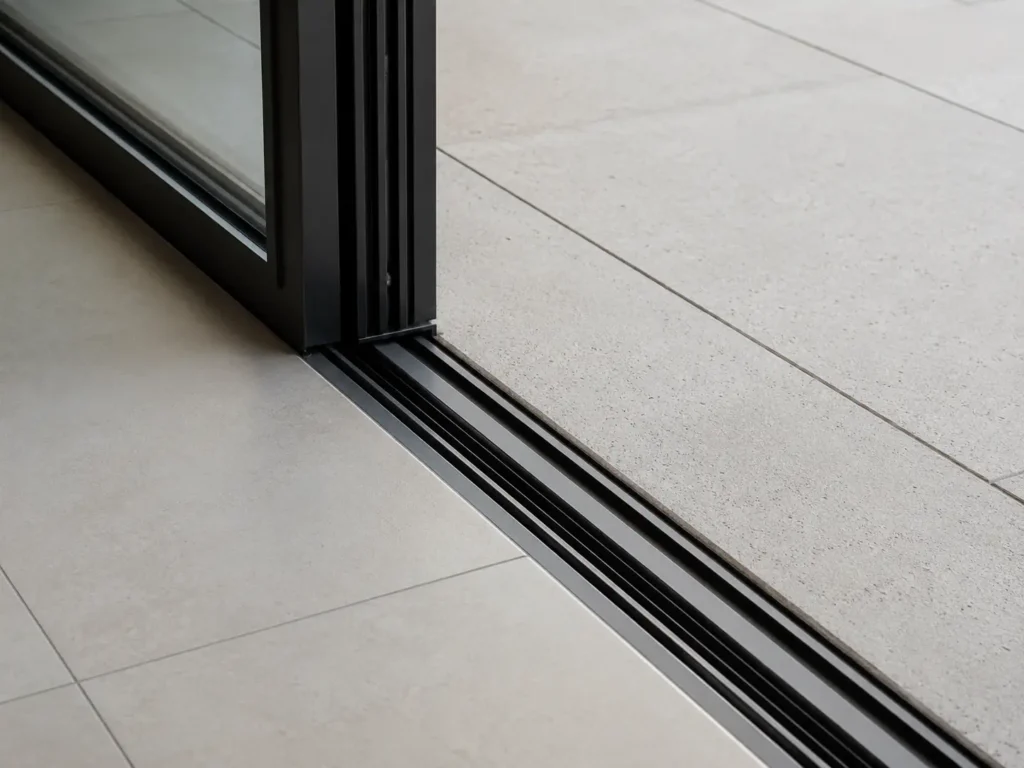
Lift and slide doors can be designed with recessed or low thresholds, helping interior flooring align more closely with a terrace or balcony.
This is particularly valuable in luxury villas, hospitality spaces and accessible routes. However, a visually flush threshold must not be evaluated on appearance alone.
The design team should also coordinate:
- Finished floor heights
- Exterior slopes
- Drainage channels
- Waterproof membranes
- Door sill outlets
- Local accessibility requirements
- Exposure to wind-driven rain
A low threshold should therefore be treated as an architectural and waterproofing detail, not merely as a door option.
Space-Efficient Opening
Lift and slide panels move parallel to the wall or fixed panel. They do not require the swing clearance of hinged doors or the stacking area of some folding-door systems.
This allows furniture, curtains and circulation zones to be planned closer to the opening.
Security and Automation Options
Depending on the system, lift and slide doors may be specified with:
- Multi-point locks
- Reinforced keepers
- Laminated safety glass
- Lockable handles
- Anti-lift components
- Opening sensors
- Concealed motors
- Smart-home controls
The weight of the door alone should not be treated as proof of security. For high-risk or code-controlled projects, request tested security classifications and confirm the exact configuration covered by the test.
Limitations to Consider Before Specification
An authoritative buying guide should also explain where lift and slide doors create additional project demands.
Higher Initial Cost
Lift and slide systems generally require more expensive hardware, profiles and fabrication than conventional sliding doors. Oversized insulated glass and export packaging can also add significant cost.
Structural Requirements
Large openings may require reinforced beams, engineered posts or additional deflection control. Excessive movement in the surrounding structure can affect alignment and long-term operation.
The door supplier should coordinate with the architect and structural engineer rather than determining the supporting structure independently.
More Demanding Installation
Even premium hardware will perform poorly if the sill is not level, the frame is twisted or the panels are incorrectly adjusted.
Installation tolerances, waterproofing, anchoring and roller adjustment are therefore critical to successful operation.
Drainage Challenges
A recessed threshold can create water-management risks when installed without suitable exterior slopes, drainage channels and sill outlets.
Projects exposed to storms, coastal winds or heavy rainfall require particular attention to the threshold detail.
Service Access
Rollers, locks, seals and drainage paths may require inspection or adjustment during the door’s service life. The project team should confirm how components can be accessed and whether replacement parts will remain available.
Frame Material Options
Thermal Break Aluminum
Aluminum is a common choice for premium residential and commercial projects because it combines structural strength, durability and relatively slim frame profiles.
Standard aluminum is highly conductive. A thermal break aluminum system includes an insulating barrier between the interior and exterior portions of the profile to reduce thermal bridging.
It is generally the preferred option for:
- Oversized glass panels
- Modern minimalist architecture
- Coastal projects with suitable surface treatment
- High-use hospitality applications
- Projects requiring custom colors or finishes
The supplier should confirm alloy, wall thickness, thermal-break design, surface finish and corrosion requirements for the project environment.
Aluminum-Clad Wood
Aluminum-clad wood combines a warm timber interior with a weather-resistant aluminum exterior.
It is suitable for luxury residences where the interior design calls for natural wood but the exterior needs lower maintenance. Buyers should review wood species, moisture treatment, coating system and corner-joint construction.
UPVC
UPVC offers good thermal insulation and is often more economical than aluminum-clad wood.
It can be suitable for moderate opening sizes and energy-conscious residential projects. For larger panels, verify reinforcement, profile deflection and hardware capacity rather than assuming that every UPVC system can support the same dimensions as a heavy-duty aluminum system.
How to Specify the Right Lift and Slide Door
Before requesting a quotation from a lift and slide door supplier, prepare the following information.
Opening Dimensions and Configuration
Provide the structural opening width and height, finished-floor levels and preferred opening pattern.
Common configurations include:
- One sliding panel with one fixed panel
- Two sliding panels meeting at the center
- Multiple sliding and fixed panels
- Panels sliding into a wall pocket
- Corner-opening systems without a permanent corner post
More complex configurations require more detailed structural and waterproofing coordination.
Panel Size and Weight
Ask the supplier to calculate the approximate glass and panel weight. The quotation should identify the exact hardware series and its rated capacity.
Do not accept a general statement such as “supports 400 kg” without confirming that the proposed panel dimensions and complete system fall within the hardware manufacturer’s limits.
Glass Specification
The correct glazing depends on climate, wind pressure, safety requirements, acoustics and panel dimensions.
Possible options include:
- Tempered safety glass
- Laminated safety glass
- Double insulating glass
- Triple insulating glass
- Low-E coatings
- Tinted or solar-control glass
- Acoustic laminates
- Heat-strengthened glass
The final glass build-up should be approved for the project rather than copied from an unrelated installation.
Whole-System Performance
Request performance information for the complete assembled door, including the frame and threshold.
Relevant values may include:
| Performance Area | Evidence to Request |
|---|---|
| Thermal insulation | Whole-product U-factor or U-value |
| Solar control | Whole-product SHGC |
| Air infiltration | Test result and test pressure |
| Water penetration | Test result, pressure and specimen configuration |
| Structural performance | Design pressure, deflection and permanent deformation |
| Acoustics | STC or OITC data where applicable |
| Security | Tested classification and tested component configuration |
| Corrosion resistance | Surface-treatment specification and suitability for exposure |
| Glass safety | Applicable safety-glazing certification |
Avoid comparing two suppliers using only profile thickness or glass thickness. The assembled product and installation detail determine actual performance.
Threshold and Drainage Detail
Ask for a sectional shop drawing showing:
- Interior and exterior floor levels
- Threshold height
- Drainage chambers
- Weep holes or outlets
- Membrane connection
- Exterior drainage channel
- Accessible-route dimensions where required
For exposed elevations, a completely flush appearance may require additional linear drainage outside the door.
Finish and Hardware
Specify the required frame color, gloss level, texture and interior–exterior finish combination.
The quotation should also identify the handle, rollers, locks, cylinders, soft-close accessories and automation system. Statements such as “German hardware” are not enough; request the brand, series and component model.
How to Choose a Reliable Lift and Slide Door Supplier
Selecting the right lift and slide door supplier is especially important for overseas projects, where mistakes may not become visible until the products reach the jobsite.
Verify Engineering Capability
The supplier should be able to review architectural drawings and prepare project-specific shop drawings.
Look for clear information about:
- Structural opening requirements
- Panel size and weight
- Glass build-up
- Wind-load assumptions
- Threshold details
- Anchoring locations
- Drainage
- Installation tolerances
A supplier that quotes only from width and height may overlook important risks.
Request Relevant Test Reports
A test report is useful only when it applies to a comparable product configuration.
Check:
- Testing organization
- Test standard
- Product model
- Frame material
- Panel configuration
- Tested dimensions
- Glass type
- Threshold design
- Test date
- Result and pressure level
A report for a small fixed window should not be used to prove the performance of an oversized sliding door.
Confirm Hardware Traceability
Premium hardware can support smoother operation and better parts availability, but brand names alone are not sufficient.
The purchase documentation should list the actual roller, gearbox, locking and handle series being supplied.
Review Manufacturing Quality Control
Ask what inspections are completed during production. A suitable quality-control process may include:
- Incoming profile and glass inspection
- Cutting and machining checks
- Frame diagonal and dimension verification
- Drainage-path inspection
- Hardware installation checks
- Panel operation and locking tests
- Surface-finish inspection
- Final packing inspection
For complex orders, request photographs, videos and QC records linked to individual opening numbers.
Evaluate Export Packaging
Large glass panels require packaging designed around their dimensions and shipping route.
The packing plan should address:
- Glass-edge protection
- Frame separation
- Hardware protection
- Moisture control
- Crate reinforcement
- Forklift and lifting positions
- Container loading sequence
- Opening-number labels
The supplier should also explain whether glass and frames will ship assembled or separately.
Check Installation and After-Sales Support
Clarify what support is available after delivery:
- Installation manual
- Shop drawings
- Video guidance
- On-site supervision
- Remote technical support
- Spare parts
- Replacement seals
- Hardware adjustment instructions
- Warranty terms and exclusions
For international projects, access to technical information and spare parts can be as important as the initial product price.
Applications in Residential and Commercial Projects
Luxury Villas and Custom Homes
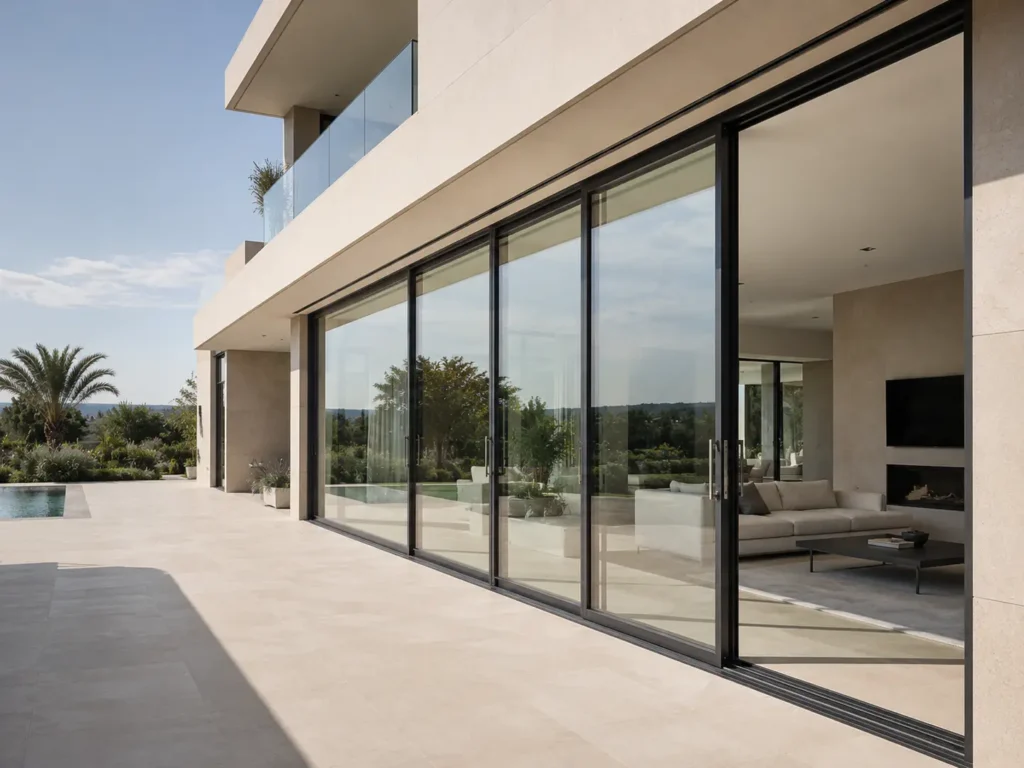
Lift and slide doors are commonly used between living rooms, terraces, gardens and pool areas. They can create a wide visual connection while preserving valuable interior floor space.
For a coordinated villa interior, the threshold and frame finish should be reviewed together with large-format Tile, feature walls made from Marble & Granite, the selected Furniture Collection, and architectural Lighting.
This coordination prevents problems such as conflicting floor heights, poorly aligned joints or frame colors that do not match the interior palette.
Hotels, Resorts and Restaurants
Hospitality projects may use lift and slide doors for guest-room balconies, restaurant terraces and event spaces.
In these applications, designers should consider:
- Frequency of operation
- Guest safety
- Acoustic performance
- Easy-to-clean tracks
- Coastal corrosion
- Maintenance access
- Replacement hardware availability
The door package should also coordinate with Flooring & Staircase, guest-room Kitchen & Wardrobe installations and Sanitary products to maintain consistent finishes and construction schedules.

Coastal and High-Wind Buildings
Large glass openings can experience substantial wind and water pressure. Coastal projects may also require enhanced corrosion resistance.
Ask for project-specific wind-load calculations, glass selection, frame reinforcement, drainage design and surface-treatment specifications. General references to “hurricane resistance” should not replace test evidence or local engineering approval.
How Much Does a Lift and Slide Door Cost?
There is no useful universal price per door because the final cost is affected by:
- Overall opening dimensions
- Number of movable and fixed panels
- Glass thickness and composition
- Aluminum, wood or UPVC frame
- Thermal-performance requirements
- Wind-load and structural requirements
- Low or recessed threshold
- Manual or motorized operation
- Surface finish
- Hardware brand and security level
- Export packaging
- Freight and installation support
A lower quotation may exclude glass, drainage accessories, motors, reinforcement, installation materials or export crates.
For a fair comparison, ask every supplier to price the same drawings and specification schedule.
Is a Lift and Slide Door Worth It?
A lift and slide door is usually worth considering when the project requires an opening that would be difficult to achieve with a standard sliding door.
It is particularly suitable when:
- The design prioritizes panoramic views
- Panels are large or heavy
- Strong compression sealing is required
- A low threshold is important
- The project has a premium architectural budget
- Long-term operation and spare-parts support can be planned
A conventional sliding door may be more cost-effective when the opening is relatively small, the climate is mild and there is no need for oversized glazing or specialized threshold detailing.
The best decision should therefore be based on project requirements rather than appearance alone.
George Homes: Project-Based Lift and Slide Door Solutions
George Homes supports overseas residential, hospitality and commercial projects with coordinated door, window and interior-material solutions.
Rather than selecting a door from dimensions alone, our project team reviews the architectural opening, climate, panel configuration, glass requirements, threshold detail and finish schedule before preparing a proposal.
Why Partner with George Homes?
- Comprehensive One-Stop Solution: Coordinate doors, windows and interior building materials through one project team to reduce finish conflicts and fragmented shipping arrangements.
- Architectural Design Support: Receive preliminary layout recommendations, shop-drawing coordination and technical review based on your project information.
- Dedicated Project Manager: Work with a consistent contact who follows the quotation, drawing confirmation, production, quality control and shipment stages.
Project-specific test reports, hardware schedules and performance information can be discussed during technical review according to the destination market and selected system.
Frequently Asked Questions
They are generally better for oversized panels, large architectural openings and projects requiring compression sealing. A standard sliding door may still be more economical for smaller openings and less demanding applications.
A correctly sized, installed and adjusted system should move smoothly despite the panel’s weight. Operation can become difficult if the sill is uneven, rollers are incorrectly adjusted, the structure deflects or the track contains debris.
Yes. Compatible systems may use concealed or surface-mounted motorized drives. Confirm panel weight, safety sensors, emergency operation, electrical requirements and smart-home compatibility.
Keep tracks and drainage outlets clean, inspect seals, check handle and lock operation, and arrange roller adjustment if movement becomes uneven. Maintenance frequency depends on use and environmental exposure.
Compare the same frame series, glass build-up, hardware model, performance requirements, finish, threshold, packaging and after-sales scope. A total price without a detailed specification is not a reliable comparison.
Request a Project-Specific Proposal
The most accurate lift and slide door quotation begins with complete project information.
Send George Homes:
- Architectural drawings
- Door schedule
- Structural opening dimensions
- Project location
- Preferred frame finish
- Glass and performance requirements
- Threshold preference
- Estimated order quantity
Our team can then review panel configuration, hardware capacity, glazing, drainage, packaging and shipping requirements before preparing a proposal.
Click the WhatsApp icon in the bottom right corner to speak with your Dedicated Project Manager, or submit your drawings to request a customized quotation and preliminary technical review.
References and Technical Resources
For additional technical guidance, consult the latest information published by:
- National Fenestration Rating Council
- NFRC Certified Products Directory
- U.S. Department of Energy — Energy Performance Ratings for Windows, Doors, and Skylights
- U.S. Department of Energy — Doors
- U.S. Access Board — Entrances, Doors, Gates, and Threshold Requirements
- SIEGENIA — Lift and Slide Hardware Systems
- SIEGENIA — PORTAL HS 400 kg Lift and Slide System
- SIEGENIA — Motorized Drives for Lift and Slide Systems
- Applicable local building-code authorities
- Accredited testing laboratories relevant to the project market
Always verify that test reports, product certifications, and code requirements apply to the exact system configuration, panel dimensions, glazing specification, threshold design, and project location being specified.