
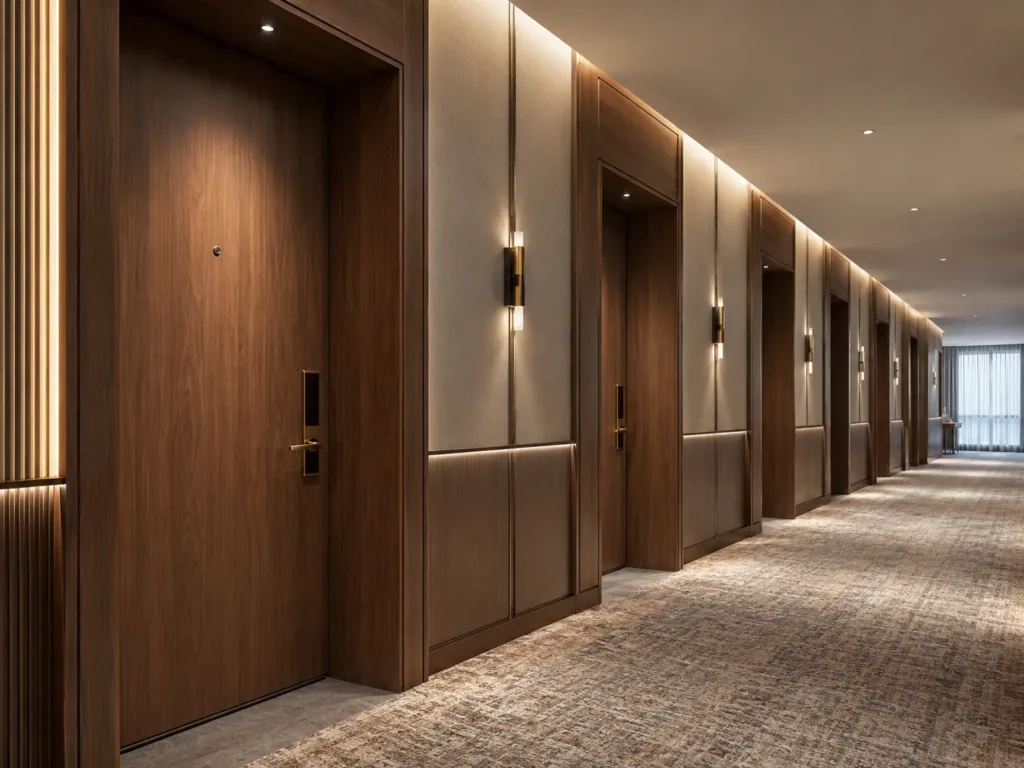
For hotel developers, contractors, and procurement managers, choosing interior doors is not only a design decision. It directly affects guest privacy, room durability, fire-code compliance, long-term maintenance costs, and the overall perception of your hotel brand.
Here is the short answer: for guest room entrances, connecting rooms, bathrooms, conference rooms, and executive areas, solid core doors are usually the better choice. For low-impact areas such as wardrobes, dry storage rooms, and some back-of-house spaces, hollow core doors can help reduce cost without damaging the guest experience.
That is why the comparison between solid core vs hollow core interior doors matters so much in hospitality projects. A door may look similar on the surface, but its internal structure can completely change its acoustic performance, fire-rating potential, impact resistance, installation cost, and service life.
As a supplier with more than 20 years of experience in One-Stop Building Project Solutions, George Homes helps hotel owners, builders, and project contractors select, customize, manufacture, inspect, and ship interior doors for global hospitality projects. This guide explains the practical differences between solid core and hollow core doors, where each should be used, and what specifications you should confirm before placing a bulk order.
Quick Comparison: Solid Core vs. Hollow Core Doors
| Factor | Solid Core Door | Hollow Core Door | Best Choice for Hotels |
|---|---|---|---|
| Acoustic privacy | Better noise reduction due to higher mass | Limited sound insulation | Solid core |
| Guest room entrance | Suitable when designed as part of a certified fire-rated assembly | Not recommended | Solid core |
| Bathroom privacy | Better privacy and premium feel | May feel light and less private | Solid core |
| Closet / wardrobe | Can be used but may increase cost | Suitable for low-impact use | Hollow core |
| Durability | Stronger against impact and daily abuse | Easier to dent or puncture | Solid core |
| Installation | Heavier; requires stronger hinges and careful installation | Lightweight; faster to install | Depends on location |
| Initial cost | Higher | Lower | Depends on budget zone |
| Long-term ROI | Better in high-traffic areas | Better only in low-impact areas | Mixed strategy |
The best hotel specification is rarely “all solid core” or “all hollow core.” The smarter approach is to use solid core doors where privacy, durability, and safety matter most, then use hollow core doors in carefully selected low-risk areas to control the overall project budget.
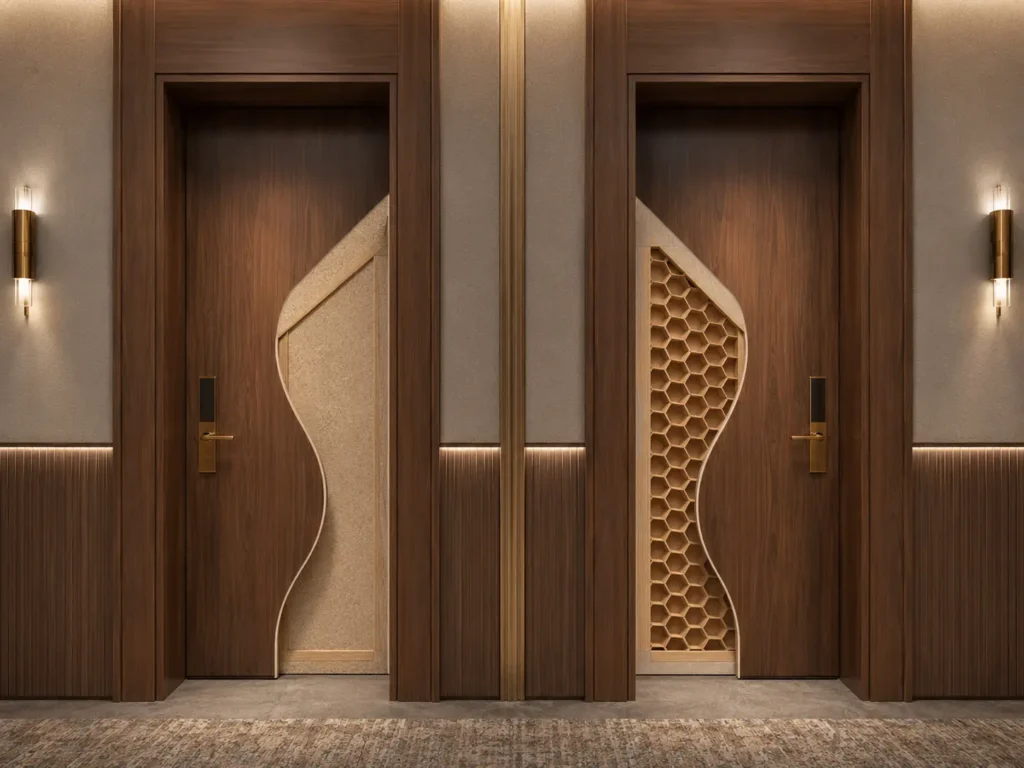
What Is a Solid Core Door?
A solid core door is built with a dense internal core, often made from engineered wood, particleboard, MDF, laminated timber, or other composite materials. The surface can be finished with wood veneer, laminate, painted panels, melamine, HPL, or other decorative materials depending on the hotel design concept.
Unlike solid wood doors, which are made from natural timber and may be more sensitive to moisture and movement, solid core doors offer a similar heavy feel while improving dimensional stability and production consistency. This makes them especially useful for hotel projects where hundreds or thousands of doors need consistent size, color, finish, hardware preparation, and packaging.
Main advantages of solid core doors include:
- Better acoustic comfort for guest rooms and corridors
- Stronger resistance to dents, scratches, and impact
- More premium opening and closing feel
- Better compatibility with fire-rated door assemblies
- Longer service life in high-traffic hospitality environments
- More suitable for luxury, boutique, resort, and branded hotel projects
The main disadvantages are higher initial cost, heavier weight, and more demanding installation requirements. For example, solid core guest room doors typically require proper hinges, reinforced frames, certified locks, closers, seals, thresholds, and accurate installation to perform as expected.
What Is a Hollow Core Door?
A hollow core door is built with a lightweight frame and a thin surface skin. The inside is not always completely empty. Many hollow core doors use a honeycomb paper core or lightweight cellular structure to help the panel keep its shape.
This construction makes hollow core doors affordable, lightweight, and easy to install. They can be a practical choice for areas where guests rarely apply impact, where privacy is not critical, and where fire-rated performance is not required.
Typical advantages of hollow core doors include:
- Lower initial material cost
- Lighter weight and easier handling
- Faster installation
- Good option for closets, wardrobes, and dry storage rooms
- Useful for budget-controlled hotel areas that are not guest-facing
However, hollow core doors have clear limitations. They usually provide weaker sound insulation, lower impact resistance, and a less premium tactile feel. In a hotel environment, these weaknesses become obvious if hollow core doors are used in the wrong place, especially for guest room entrances, bathrooms, connecting rooms, or noisy corridors.
Why Door Core Selection Matters More in Hotels Than in Homes
In residential projects, a homeowner may tolerate a lightweight bedroom or closet door. In hotels, the door performs under much harsher conditions.
A hotel door is opened and closed by hundreds of different guests. It may be hit by luggage, cleaning carts, housekeeping equipment, room-service trolleys, and maintenance tools. It must also support hardware such as locks, card readers, closers, hinges, peepholes, door viewers, seals, and sometimes automatic drop seals.
More importantly, hotel guests judge the room within seconds. A lightweight, noisy, or easily damaged door can make the entire room feel cheaper, even if the furniture and finishes are attractive.
For hotel projects, doors affect four business outcomes:
- Guest satisfaction
- Maintenance and replacement cost
- Fire and safety compliance
- Brand perception
This is why hotel developers should not compare door types only by unit price. A cheaper door can become more expensive if it causes complaints, replacements, installation issues, or failed inspections.
Acoustic Privacy: Why Solid Core Doors Usually Perform Better
Noise is one of the most common reasons guests feel dissatisfied with a hotel stay. Corridor conversations, slamming doors, elevator noise, housekeeping activity, and sound from neighboring rooms can all affect sleep quality.
Solid core doors usually perform better because mass helps reduce airborne sound transmission. In simple terms, a heavier and denser door panel blocks more sound than a lightweight hollow panel.
For hotel guest rooms, acoustic performance should not depend on the door slab alone. A good hotel sound-control strategy should also consider:
- Door core density
- Door thickness
- Frame material and installation accuracy
- Perimeter seals
- Bottom seal or automatic drop seal
- Threshold design
- Gaps around the door
- Wall and corridor construction
- Connecting door layout
A solid core door with poor sealing can still leak sound. A well-specified hotel door assembly should combine a dense door leaf with proper frame, hardware, and sealing details.
For guest room entrances and connecting rooms, George Homes generally recommends solid core doors with acoustic seals. For wardrobes or storage rooms, hollow core doors can be acceptable if acoustic privacy is not important.
Fire Rating and Code Compliance: Do Not Judge by Door Core Alone
One of the biggest mistakes in hotel door procurement is treating the door slab as the entire fire-rated system. In commercial projects, fire performance depends on the complete door assembly, not only the core.
A fire-rated door assembly may include:
- Door leaf
- Frame
- Hinges
- Lockset
- Door closer
- Intumescent strips
- Smoke seals
- Threshold
- Glazing, if applicable
- Label and certification
- Installation method
For hotel guest room entrances, corridor doors, stair doors, service doors, and mechanical room doors, the required fire rating depends on local building codes, wall assembly rating, project type, building height, sprinkler system, and authority having jurisdiction.
This is why the safer procurement approach is not simply asking, “Is this door solid core?” Instead, ask:
- Is the complete door assembly tested and certified?
- What fire rating is required: 20, 30, 45, 60, or 90 minutes?
- Which standard applies to this project market?
- Are the frame, hardware, seals, and closer included in the tested assembly?
- Can the supplier provide labels, test reports, and compliance documents?
- Will the door arrive pre-machined for the correct lock, hinge, closer, and access-control system?
Solid core doors are generally more suitable for fire-rated hotel applications, but the final decision must be based on the tested assembly and local project requirements.
Durability: The Hidden Cost of Choosing the Wrong Door
Hotels are high-traffic environments. A guest room door may face years of impact from suitcases, cleaning equipment, and frequent use. If a hollow core door is installed in a high-impact area, damage can appear quickly.
Common issues with low-quality or wrongly specified hollow core doors include:
- Surface punctures
- Edge damage
- Loose hinges
- Poor screw holding
- Warping or twisting
- Weak lock fixing
- Poor sound control
- Shorter replacement cycle
Solid core doors are stronger and more stable in demanding areas. They usually hold hardware better and feel more secure when opened or closed. This is especially important for branded hotels, serviced apartments, resorts, and long-stay hospitality projects where room downtime directly affects revenue.
For project managers, the correct question is not “Which door is cheaper?” but “Which door reduces maintenance and guest complaints over the next five to ten years?”
Where to Use Solid Core Doors in a Hotel
Solid core doors should be used wherever privacy, safety, durability, or premium guest experience is important.
Guest Room Entry Doors
This is the most important door in the hotel room. It affects security, sound insulation, corridor noise, fire safety, and first impression. Guest room entry doors should usually be solid core and specified as part of a compliant fire-rated door assembly where required.
Recommended specification points:
- Solid core or certified fire-rated core
- Appropriate fire rating based on local code
- Acoustic perimeter seals
- Door closer
- Hotel lock or smart lock preparation
- Reinforced hinge area
- Durable finish such as veneer, laminate, HPL, or painted system
- Accurate packing and room-number labeling for site installation
Connecting Doors Between Guest Rooms
Connecting doors are one of the most sensitive acoustic locations in a hotel. Guests on both sides expect privacy. If the door is too light, conversations, TV noise, and bathroom sounds can easily pass through.
For connecting rooms, use solid core doors with proper seals. In some projects, double-door systems or enhanced acoustic details may be required.
Guest Bathrooms
Bathroom privacy is a major part of comfort. Lightweight doors, glass doors, poorly sealed sliding doors, or thin hollow core doors can make guests feel uncomfortable.
For mid-range to luxury hotels, solid core bathroom doors create a better sense of privacy and quality. They also match the “quiet luxury” feeling expected in modern hospitality interiors.
Conference Rooms and Executive Lounges
Business travelers need privacy. Meeting rooms, executive lounges, VIP areas, and private dining rooms should not use lightweight doors that leak sound easily. Solid core doors help support a quieter, more professional environment.
Staff Corridors and High-Impact Back-of-House Areas
Not every back-of-house door needs to be premium, but doors in high-impact service corridors, housekeeping rooms, and maintenance areas should be durable enough to survive daily operations. Solid core or other commercial-grade options may reduce replacement frequency.
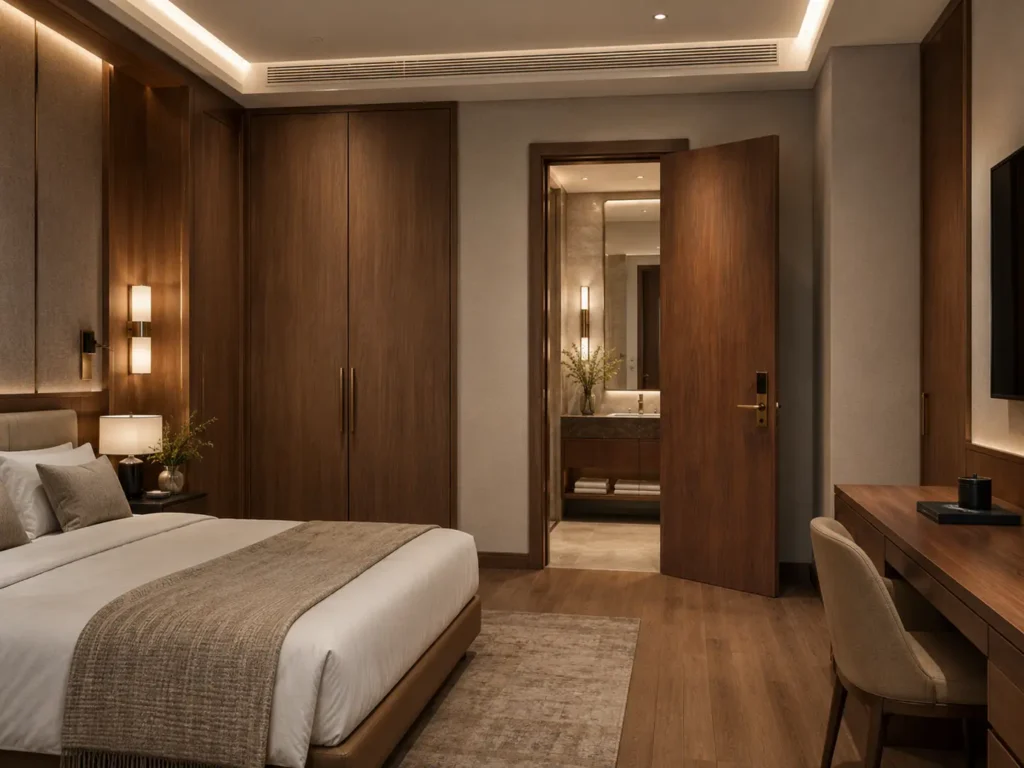
Where Hollow Core Doors Can Still Make Sense
Hollow core doors are not “bad.” They are simply suitable for different locations. In a hotel project, they can help reduce cost when used strategically.
In-Room Closets and Wardrobes
For closet and wardrobe doors, hollow core construction can be acceptable because the door is not usually exposed to heavy impact or strict acoustic requirements. It can be a smart cost-saving choice when the finish is coordinated with the room design and Custom Hotel Wardrobes.
Dry Storage Rooms
For low-risk dry storage areas, hollow core doors may be enough if fire rating, moisture resistance, and impact resistance are not required.
Pantry or Staff-Only Light-Use Areas
Some staff-only areas may use hollow core doors if they are not located in fire-rated walls, high-traffic routes, or wet zones. However, the final specification should always be checked against project drawings and local code requirements.
Project-Based Door Selection Matrix
| Hotel Area | Recommended Door Type | Reason |
|---|---|---|
| Guest room entrance | Solid core / certified fire-rated assembly | Security, fire rating, acoustic comfort, premium feel |
| Guest bathroom | Solid core | Privacy, durability, better guest experience |
| Connecting room | Solid core with seals | Stronger sound reduction |
| Wardrobe / closet | Hollow core or lightweight solid option | Cost saving in low-impact location |
| Conference room | Solid core | Acoustic privacy |
| Executive lounge | Solid core | Premium feel and quiet environment |
| Dry storage | Hollow core or commercial-grade option | Depends on impact and code requirements |
| Mechanical room | Fire-rated commercial door | Code and safety requirements |
| Stairwell / exit area | Fire-rated assembly | Life safety and code compliance |
| Service corridor | Solid core or commercial-grade door | Impact resistance |
This mixed specification strategy gives hotel developers better cost control without sacrificing the guest-facing experience.
Procurement Checklist for Hotel Project Doors Wholesale
When sourcing hotel project doors wholesale, do not only ask for price and size. Ask for the full technical and project-support details.
Before confirming an order, prepare the following information:
- Door schedule
- Floor plan and room count
- Door opening size
- Wall thickness
- Door thickness
- Required fire rating
- Required acoustic performance
- Finish sample or color code
- Hardware brand and model
- Lock type and smart access-control requirements
- Hinge direction
- Frame type
- Seal requirements
- Quantity by door type
- Packaging and labeling requirements
- Destination port
- Site delivery sequence
- Project deadline
A professional supplier should help you review these details before production. Missing one small item, such as lock hole position or frame thickness, can cause expensive installation delays on site.

Quality Control Points Before Shipment
For hotel projects, quality control should be performed before the doors leave the factory. This is especially important for overseas procurement, where returning or replacing doors after shipment is costly.
Recommended inspection points include:
- Door size and thickness
- Surface finish and color consistency
- Edge banding quality
- Flatness and warping tolerance
- Hinge and lock machining accuracy
- Frame matching
- Fire label and documentation, if required
- Moisture protection
- Scratch and impact protection
- Carton labeling by room or floor
- Loading plan for container shipment
George Homes can support hotel clients with coordinated manufacturing, inspection, packaging, and consolidated shipping as part of our One-Stop Building Project Solutions.
Cost Comparison: Initial Price vs. Long-Term ROI
Hollow core doors usually win on initial price. However, hotel procurement should consider total cost of ownership.
A door with a lower purchase price may become more expensive if it:
- Gets damaged easily
- Requires frequent replacement
- Causes guest complaints
- Fails inspection
- Does not fit the required hardware
- Delays room handover
- Reduces the perceived quality of the hotel
Solid core doors require a higher upfront investment, but they usually offer better value in guest-facing and high-use areas. They help protect the room experience, reduce maintenance, and support a more premium brand impression.
For developers working on large hotels, serviced apartments, resorts, or mixed-use hospitality projects, the best cost strategy is targeted specification: invest in solid core doors where performance matters and use hollow core doors only where the risk is low.
Why Hotel Builders Choose George Homes
Managing a hotel project across multiple suppliers can quickly become complicated. Doors, windows, wardrobes, flooring, sanitary ware, lighting, furniture, stone, appliances, and hardware all need to match the design, budget, timeline, and shipping plan.
George Homes helps simplify this process with integrated supply and project coordination.
Through our Commercial Doors & Windows supply chain, we can help hotel developers source interior doors, entry doors, frames, finishes, and related building materials with consistent quality and coordinated delivery.
Beyond doors, we also support full-project sourcing, including tile and sanitary ware, marble and granite, kitchen and wardrobe systems, flooring and staircases, lighting, furniture collections, furnishings-supplies, and heavy project requirements through Appliances & Sourcing.
Instead of communicating with many separate factories, clients can work with one team, one coordinated project process, and one consolidated shipping plan.
Dedicated Support from Design to Delivery
Every hotel project has different requirements. A resort in a humid coastal market may need different door materials and finishes than a city hotel, serviced apartment, or luxury villa project.
When you work with George Homes, you can coordinate your door schedule, drawings, finish samples, technical requirements, packaging details, and shipping plan with a Dedicated Project Manager.
Our team can help with:
- Door type recommendation
- Material and finish selection
- Shop drawing support
- Sample confirmation
- Bulk production coordination
- Quality control before shipment
- Container loading and logistics planning
- One-stop sourcing for matching hotel materials
We cordially invite you to visit our expansive offline showroom to compare door weight, finish quality, hardware options, acoustic details, and complete hotel interior solutions in person.
FAQ: Solid Core vs. Hollow Core Interior Doors
No. No interior door is completely soundproof by itself. However, solid core doors usually provide better acoustic performance than hollow core doors because of their higher density and mass. For hotel guest rooms, acoustic seals, proper frame installation, and bottom sealing are also important.
A solid core door can be part of a fire-rated door assembly, but the door core alone does not guarantee compliance. The complete assembly, including the door leaf, frame, hardware, seals, closer, and label, must match the required standard and local building code.
Hollow core doors can be used for wardrobes, closets, dry storage, and some low-impact back-of-house areas. They should not be used in locations requiring fire rating, acoustic privacy, high durability, or strong hardware support.
To get an accurate quote for hotel project doors wholesale, provide your door schedule, drawings, quantity, door size, finish requirements, fire rating needs, hardware details, destination port, and project timeline. The more complete your information is, the more accurate the quotation and production plan will be.
Conclusion: Use the Right Door in the Right Location
The choice between solid core vs hollow core interior doors should not be based on price alone. In hotel projects, doors influence guest comfort, privacy, safety, maintenance cost, and brand value.
For guest room entrances, bathrooms, connecting rooms, conference spaces, and premium areas, solid core doors are the stronger long-term investment. For wardrobes, closets, and selected low-impact spaces, hollow core doors can be used strategically to control budget.
If you are planning a hotel, resort, serviced apartment, or commercial renovation project, George Homes can help you build a practical door specification plan and coordinate it with your wider interior material package.
Ready to streamline your hospitality project?
Send us your drawings, door schedule, or project brief today.
Contact Us Today for a Custom Wholesale Quote or connect with our team through the WhatsApp icon in the bottom right corner. A George Homes Dedicated Project Manager will help you review your hotel blueprint and recommend the right door solution for your project.
Reference Standards and Further Reading
- Google Search Central: Creating helpful, reliable, people-first content
- ASTM E413: Classification for Rating Sound Insulation
- ASTM E90: Laboratory Measurement of Airborne Sound Transmission Loss
- NFPA 80: Standard for Fire Doors and Other Opening Protectives
- International Building Code: Fire and smoke protection features for door assemblies
- Hotel guest sleep and satisfaction research related to noise and room attributes