Ask any luxury villa owner or boutique hotel guest about their biggest daily bathroom frustration, and it’s rarely about water pressure or tile color. The real irritation? The bottleneck. One person is grooming at the sink while the other needs the toilet. Steam fogging up the mirror just as you finish shaving. A toothbrush sitting six feet from an open toilet.
For decades, the standard architectural response was simple: pack the toilet, shower, and sink into a single enclosed space and call it a day. But modern high-end villa owners, boutique hoteliers, and forward-thinking contractors are now asking a better question: Why are we still designing bathrooms like efficiency apartments?
The answer is, we shouldn’t be. Moving the sink outside the bathroom—and adopting a strict dry and wet separation layout—is rapidly becoming the new benchmark in premium property development. If you’re a project manager or contractor looking to elevate your next build, this approach delivers measurable returns in hygiene, space efficiency, asset longevity, and architectural prestige. Here’s everything you need to know to specify, design, and execute this layout with confidence.
What Exactly is “Dry and Wet Separation” in Modern Layouts?
In architectural terms, “dry and wet separation” divides a bathroom into two distinct zones based on moisture exposure.
The wet zone contains the shower, bathtub, and toilet—areas that generate humidity, direct water spray, and require full waterproofing. The dry zone encompasses the vanity, sink, mirrors, and grooming area—spaces that benefit from a climate-controlled, low-moisture environment.
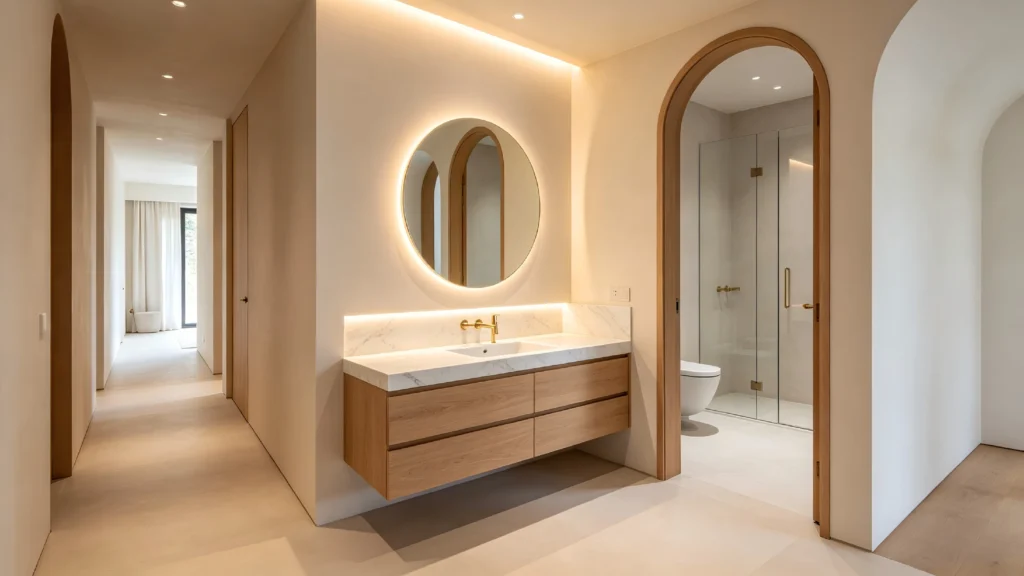
The traditional approach uses Metal & Glass shower enclosures to create a partial barrier within the same four walls. The advanced approach? Physical separation. The dry zone is relocated entirely outside the primary bathroom door—typically integrated into a transition hallway, a master bedroom alcove, or a walk-through dressing area.
This isn’t just a stylistic preference. It fundamentally restructures traffic flow, unlocks simultaneous multi-user access, and transforms the wash area from a hidden utility into a visible architectural feature.
Top 4 Benefits of Moving the Wash Area Outside
Demonstrable Hygiene and Moisture Control
Bathrooms are humid by nature. But they’re also contamination zones. Peer-reviewed studies on toilet plume aerosolization confirm that flushing can propel microscopic particles up to six feet—landing on exposed toothbrushes, cosmetics, and hand towels in a traditional combined layout.
By physically separating the sink from the toilet and shower, you create a hard barrier against cross-contamination. Toothbrushes and grooming tools stay in a dry, climate-controlled alcove. Mirrors remain fog-free. Towels don’t absorb ambient shower humidity.
For hoteliers, this layout directly supports higher guest hygiene ratings—a factor increasingly correlated with ADR (Average Daily Rate) and positive online reviews. For residential developers, it’s a compelling wellness-driven selling point that resonates with hygiene-conscious luxury buyers.
Maximized Space Efficiency Through Parallel Use
In a conventional bathroom, if one person is showering, the entire space is effectively off-limits. The sink sits idle. The toilet is inaccessible. For a family villa during the morning rush—or a hospitality suite designed for couples—this is a fundamental design failure.
An external wash area unlocks parallel usage. One person showers in the wet zone. Another brushes their teeth and styles their hair at the external vanity. The toilet remains available. Three users. Zero conflict.
This peak-hour efficiency is not a minor convenience. For high-traffic hospitality suites, it’s an operational advantage. For residential projects, it’s a daily quality-of-life upgrade that potential buyers or tenants will feel the moment they walk through.
Extended Asset Lifespan and Reduced Warranty Risk
Constant exposure to humidity and direct water splashes is the silent killer of bathroom joinery. Even high-quality MDF or wood veneer vanities, when subjected to years of steam cycling and occasional splashing, can begin to warp, delaminate, or develop mold within three to five years. Many vanity manufacturers explicitly void warranties on units installed in non-ventilated wet environments.
Relocating the vanity to a dry hallway or bedroom alcove effectively removes this moisture variable. The unit operates in a climate-controlled environment, dramatically extending its service life.
For developers, this translates to a tangible reduction in callback requests and warranty claims. For project managers, specifying an external dry zone means you can confidently offer extended warranties on joinery—without the actuarial headache of moisture-related failures.
Elevated Architectural Aesthetics: From Utility to Focal Point
An external sink isn’t displaced plumbing. When executed with the right design language, it becomes a statement piece.
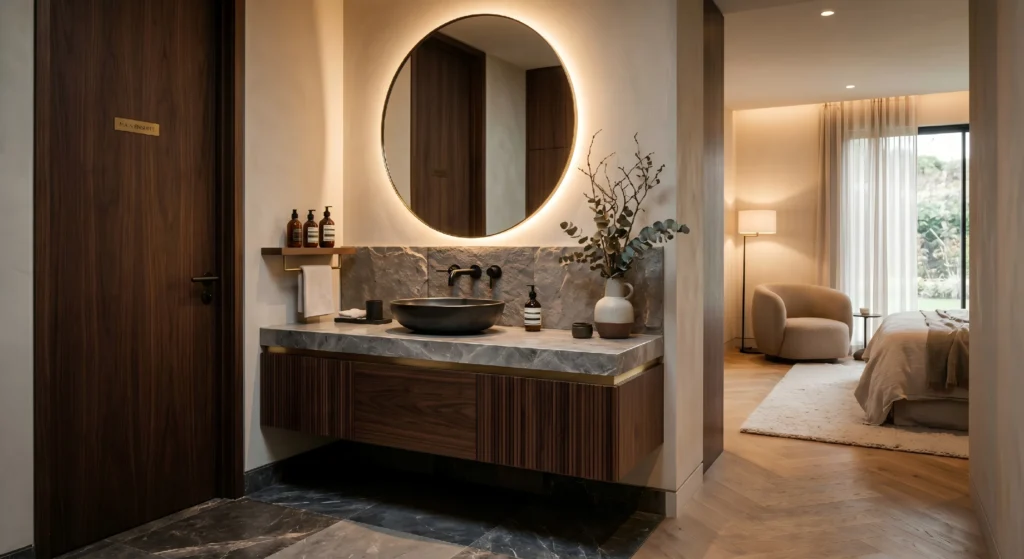
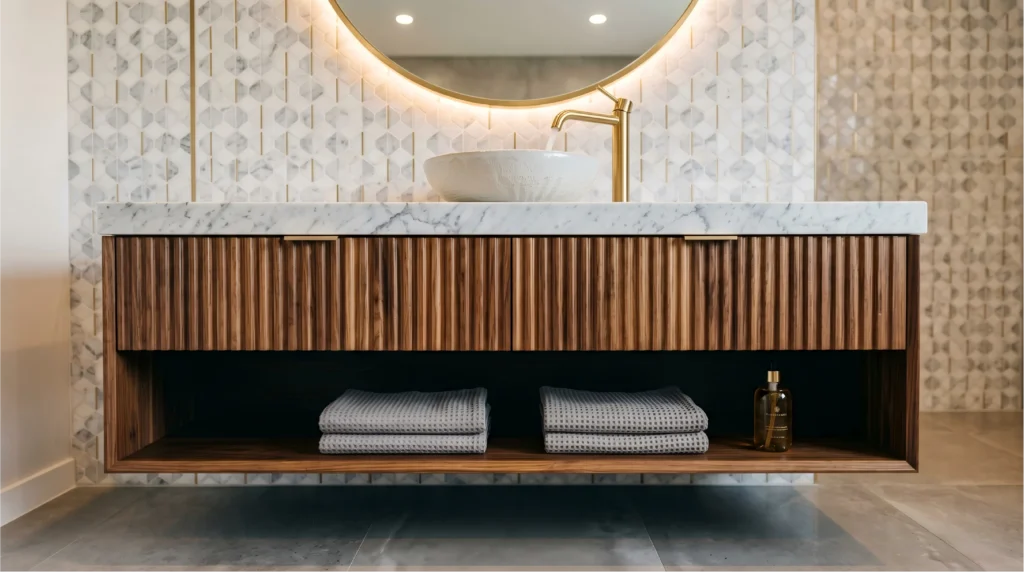
Imagine walking into a master suite. Before you even reach the sleeping area, you pass a custom marble-clad floating vanity, softly illuminated by a backlit LED mirror and flanked by floor-to-ceiling integrated wardrobes. The stone carries a subtle book-matched grain. Matte black fixtures anchor the composition. A textured tile backsplash adds rhythm and depth.
This is no longer a utilitarian wash station hidden behind a door. It’s a transitionary luxury amenity—a moment of arrival that elevates the entire bedroom experience.
Project managers are increasingly treating these open wash areas as an extension of the property’s Furniture Collection, specifying vanities not as plumbing fixtures but as freestanding design objects that bridge the language between hallway, dressing room, and master suite.
Architect’s Note: 3 Non-Negotiable Constraints Before Reconfiguring the Layout
The benefits are clear. But improper execution leads to costly rework. Before relocating any sink outside the bathroom, our engineering team insists on three critical considerations. Overlooking any one of them can compromise the entire installation.
Floor Drain and Extended Waterproofing
An external dry zone is dry in theory—but not immune to accidents. Supply line leaks, sink overflows, and cleaning splashes can and do occur. Treat this area as a “wet-adjacent” space.
- Requirement: Install a dedicated floor drain in the external vanity zone.
- Requirement: Extend the waterproofing membrane a minimum of 0.5 meters (approximately 20 inches) beyond the vanity footprint, with a minimum 2% floor slope toward the drain.
- Rationale: If a flexible hose bursts while the property is unoccupied, this passive protection prevents catastrophic water damage to adjacent bedroom flooring or lower-level ceilings.
Plumbing Core Distance and Gravity Drainage
Sinks rely on gravity for wastewater drainage. Unlike pressurized supply lines, drain pipes cannot simply be routed wherever convenient. The distance between the relocated sink and the main plumbing stack is a hard physical constraint.
- Rule of Thumb: Drainage pipes require a minimum slope of 2 cm per meter (approximately 1/4 inch per foot) to function reliably.
- Implication: If your proposed vanity location sits more than 3-4 meters from the stack, verify that the floor structure provides sufficient depth to accommodate the required slope without compromising slab integrity or ceiling height below.
- Workaround: For island vanities or layouts where the distance is insurmountable, specify a macerating pump system. This adds upfront cost but eliminates gravitational constraints.
Hot Water Lag and Recirculation Strategy
When a sink moves further from the water heater, the volume of cold water sitting in the supply line increases. For an external vanity in a master suite, this can mean waiting 30-60 seconds for hot water to arrive—an unacceptable experience in a luxury context.
- Solution: Specify a hot water recirculation pump with a dedicated return line or a point-of-use tankless water heater integrated discreetly beneath the floating vanity.
- Coordination: This requires early-stage MEP coordination. The electrical team must provision power. The plumbing team must plan the return loop. The joinery team must allow ventilation and access within the vanity carcass. Do not leave this as a post-installation retrofit.
Traditional Bathroom vs. Separated Vanity Layout: A Quantitative Comparison
To understand why this layout is dominating modern blueprints, review the side-by-side comparison below. These are not theoretical distinctions—they represent measurable operational and financial differences across a building’s lifecycle.
| Feature | Traditional Combined Layout | External Wash Area (Dry/Wet Separation) |
| Simultaneous User Capacity | 1 person (entire room occupied) | 2-3 people (parallel wet and dryzone use) |
| Hygiene & Cross-Contamination | High risk. Toilet plumes can travel up to 6 ft, contaminating exposed grooming items. | Minimal risk. Complete physical barrier between sanitary fixtures and grooming zone. |
| Joiner Warranty & Durability | 3-5 year typical lifespan for MDF/veneer in humid conditions.Many warranties void. | Climate-controlled dry zone. Lifespan extended to 10-15+ years with full warranty coverage. |
| Morning Peak Efficiency | Bottleneck. Single user blocks all amenities. | High throughput. Parallel grooming, showering, and toilet use. |
| Design Flexibility | Constrained by wet-room plumbing and ventilation requirements. | Open. Vanity integrates with bedroom/hallway millwork and lighting design language. |
| Resale & ADR Impact | Standard expectation. No premium. | Demonstrable premium: higher guest satisfaction scores, stronger buyer appeal. |
Design Spotlight: Specifying Custom Floating Vanities for External Wash Areas
When integrating a sink into a hallway or bedroom alcove, bulky traditional cabinets quickly make the space feel cramped and disconnected from the surrounding architecture. This is why custom floating vanities—wall-mounted units with no floor contact—have become the de facto standard for external dry zones.
A floating vanity creates visual lightness. The uninterrupted floor plane makes the alcove feel larger. Daily cleaning becomes effortless—no plinth returns, no awkward dust traps. But specification matters. To elevate the result from a basic wash station to a premium architectural feature, every material and fixture decision must be intentional.
Material Integration That Defines the Space
When integrating a sink into a hallway or bedroom alcove, bulky traditional cabinets quickly make the space feel cramped and disconnected from the surrounding architecture. This is why custom floating vanities—wall-mounted units with no floor contact—have become the de facto standard for external dry zones.
A floating vanity creates visual lightness. The uninterrupted floor plane makes the alcove feel larger. Daily cleaning becomes effortless—no plinth returns, no awkward dust traps. But specification matters. To elevate the result from a basic wash station to a premium architectural feature, every material and fixture decision must be intentional.
Material Integration That Defines the Space
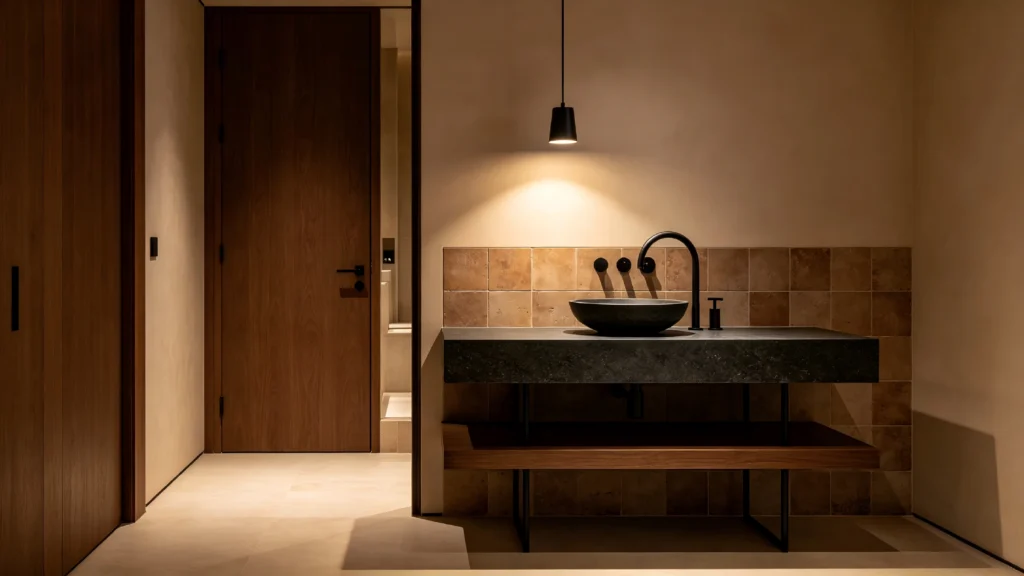
- Premium Countertops: For luxury residential and hospitality projects, natural stone remains the benchmark. High-grade Marble & Granite—specifically Statuario, Calacatta, or Nero Marquina—delivers a durable, timeless finish. For high-traffic commercial applications, engineered quartz offers equivalent aesthetics with superior stain resistance and zero sealing maintenance.
- Artistic Backsplashes: The wall behind the vanity is a canvas. Textured porcelain Tile—think fluted profiles, geometric mosaics, or hand-glazed zellige—introduces tactile depth while protecting the wall surface. Extend the backsplash to the full vanity width, minimum 400mm height, with a continuous silicone seal at the countertop junction.
- Layered Lighting: A single overhead fixture flattens the space and casts unflattering shadows on the face. Specify ambient LED cove lighting above the mirror for indirect illumination, paired with task-rated sconces or a backlit mirror at eye level. Color temperature: 3000K-3500K for warm, skin-flattering light that matches adjacent bedroom lighting.
- Fixtures and Fittings: The Sanitary Wares & Fittings serve as the jewelry of the installation. A vessel sink in cast mineral composite paired with a floor-mounted or wall-mounted tall faucet creates a sculptural moment. Matte black, brushed nickel, or unlacquered brass—the finish must echo the hardware language established across the project’s doors, cabinetry, and lighting.
A Case in Point: Hospitality Application
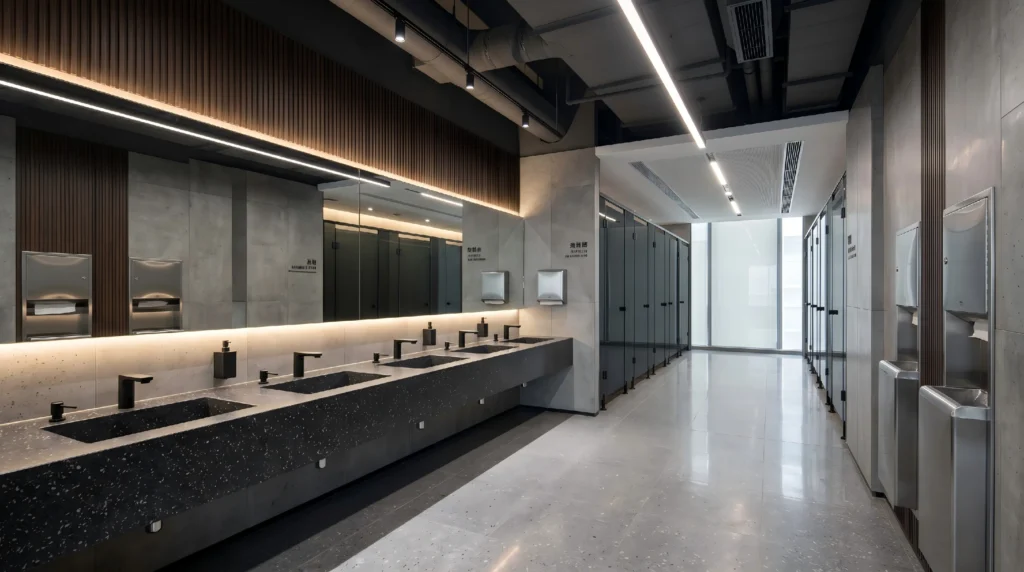
On a recent 12-unit boutique hotel project, our design team specified Statuario marble-clad floating vanities for external wash alcoves in every suite. The wall-mounted configuration freed 15% of visible floor area compared to the original floor-standing cabinetry proposal. Integrated 3500K backlit mirrors and matte black vessel faucets created a grooming station that guests actively photographed and shared on social media. Within three months of opening, the property reported a measurable increase in direct bookings, specifically mentioning “bathroom design” in post-stay surveys.
How George Homes Simplifies Your Custom Bathroom Projects
Executing a flawless dry and wet separation layout requires precision across multiple trades. Cabinetry, stone fabrication, plumbing fixtures, lighting, and waterproofing—each element must arrive on time, correctly specified, and visually coherent. The traditional procurement approach—sourcing these components from separate factories—introduces risk at every handoff point. Material shade mismatches. Conflicting lead times. One delayed component is stalling the entire installation.
George Homes eliminates this fragmentation.
With 20 years of global supply and project delivery experience, we provide a genuine “One-Stop Building Project Solution.“ When you partner with us, you receive a Dedicated Project Manager who serves as your single point of accountability for the entire procurement scope. We manage the factories so you don’t have to.
Our in-house design team collaborates directly with your architects or interior designers to ensure the external vanity aligns perfectly with the broader interior language. From the marble slab selection to the backsplash tile grout color, every specification is documented, cross-checked, and consolidated under a single purchase order and a unified quality control process.
- Doors & Windows
- Flooring & Staircase Systems
- Kitchen & Wardrobe Joinery
- Appliances & Sourcing
- General Project Materials & Supplies
One partner. One quality standard. One delivery timeline.
Ready to Redefine Your Next Building Project?
Your clients expect flawless execution. Don’t let fragmented procurement slow down your high-end builds or compromise your design intent. Whether you’re constructing a private luxury villa or upgrading a commercial hospitality property, George Homes brings the design expertise, manufacturing capacity, and logistics reliability to bring your vision to life—on time and on specification.
We invite builders, contractors, and project managers to visit our global offline showrooms and experience our material quality and craftsmanship firsthand.
Let’s build something extraordinary together.
👉 [Get Your Free Layout Feasibility Study & Quote] — Submit your floor plan and our team will provide a complimentary vanity specification sheet, including sanitary ware and lighting recommendations, alongside your customized project quote.
Prefer a direct conversation? Contact your Dedicated Project Manager via the WhatsApp button in the bottom right corner to discuss your specific dry-wet separation requirements today.