
For US builders, developers, hotel owners, and project managers, windows are not just a design detail. They are a major cost center that affects construction budget, energy performance, installation schedule, building code compliance, and long-term property value.
That is why more US project buyers are asking the same question:
Is importing windows from China worth it?
The simple answer is: yes, it can be worth it for the right project — but only when landed cost, compliance, quality control, and logistics are managed correctly.
For small replacement jobs, local purchasing may be faster and easier. But for large apartment buildings, hotels, villas, commercial buildings, and multi-category construction projects, importing windows from China can create strong cost advantages, especially when buyers need custom aluminum systems, thermal break profiles, large glass sizes, and bulk procurement.
However, the factory price alone does not tell the full story. A quote that looks attractive at first may become expensive if freight, duties, tariffs, port fees, inland trucking, compliance documents, and inspection risks are not calculated from the beginning.
This article breaks down the real landed cost of importing windows from China to the US, compares aluminum vs. uPVC windows commercial cost, explains compliance factors such as NFRC and AAMA / FGIA standards, and shows how builders can reduce risk through one-stop sourcing with George Homes.
1. Why US Builders Are Comparing Local Window Suppliers with China Factory-Direct Options
Construction costs in the US remain under pressure. Labor costs, materials, project delays, financing costs, and subcontractor coordination all affect profitability. For developers and general contractors, every major material package needs to be reviewed carefully.
Windows are one of the most important packages because they combine several cost drivers:
| Cost Driver | Why It Matters |
|---|---|
| Frame material | Aluminum, thermal break aluminum, uPVC, wood, or composite |
| Glass specification | Single, double, triple glazing, Low-E, laminated, tempered, insulated glass |
| Size and customization | Standard windows are cheaper; oversized or custom systems cost more |
| Energy performance | U-Factor, SHGC, air leakage, and climate-zone requirements |
| Structural performance | Wind load, water penetration, air infiltration, design pressure |
| Installation system | Flange, sub-frame, curtain wall integration, waterproofing details |
| Logistics | Packaging, container loading, port handling, inland transportation |
A local US distributor can provide convenience, shorter lead times, and familiar warranty handling. But that convenience often includes distributor markup, warehousing cost, local overhead, and limited customization flexibility.
China factory-direct sourcing gives buyers access to manufacturing scale, custom profiles, competitive labor and production costs, and a wide range of product options. This is especially attractive for commercial projects where hundreds or thousands of window units are required.
The key is not simply to ask, “Which supplier is cheaper?”
The better question is:
Which sourcing model gives the lowest total project cost while meeting required performance, schedule, and compliance standards?
2. Base Price Comparison: US Local Supplier vs. China Factory Quote
A common mistake in window procurement is comparing a US local supplier quote with a China factory quote line by line without considering what each quote includes.
A US supplier quote may include warehousing, local delivery, distributor margin, and sometimes basic support. A China factory quote may be based on EXW, FOB, or another Incoterm, which means the buyer still needs to calculate freight, insurance, customs clearance, duties, port fees, and inland transportation.
That is why the first factory quote is not the final cost.
Why the Initial Factory Quote Can Be Misleading
A factory quote usually focuses on the manufacturing cost of the product. It may include:
- Aluminum profile or uPVC profile
- Glass
- Hardware
- Surface finish
- Screens or accessories if specified
- Basic packaging
- Production labor
- Factory margin
But it may not include:
- Ocean freight
- Cargo insurance
- US customs duties
- Section 301 additional tariffs if applicable
- Merchandise Processing Fee
- Harbor Maintenance Fee
- Customs broker fee
- Port handling
- Chassis, drayage, or demurrage risk
- Inland trucking
- Job-site unloading
- Testing, certification, or project-specific documentation
For this reason, US buyers should always request both a factory quote and a landed cost estimate.
Commercial Window Cost per Square Foot: What Affects the Number?
There is no universal commercial window cost per square foot. The number can change significantly depending on the project specification.
The following factors have a major impact:
| Factor | Cost Impact |
|---|---|
| Frame material | Thermal break aluminum is usually more expensive than basic aluminum or uPVC |
| Glass type | Laminated, tempered, Low-E, argon-filled, and oversized glass increase cost |
| Window type | Fixed windows are usually cheaper than operable windows |
| Hardware | High-quality locks, hinges, rollers, and handles increase durability and cost |
| Surface finish | Powder coating, anodizing, wood grain, or custom colors affect price |
| Performance rating | Higher structural, acoustic, thermal, or water resistance requirements raise cost |
| Quantity | Larger orders usually reduce unit cost |
| Packaging | Export-grade packaging adds cost but protects products during shipping |
For B2B buyers, it is better to compare window packages by specification rather than by a single square-foot number.
A low-cost window with poor air sealing, weak hardware, or insufficient documentation may create higher costs later through installation problems, failed inspections, callbacks, water leakage, or energy performance issues.
Local Supplier vs. China Factory-Direct Sourcing
| Comparison Point | Local US Supplier | China Factory-Direct |
|---|---|---|
| Initial product price | Usually higher | Usually lower |
| Customization flexibility | Limited to available product lines | Strong customization options |
| Lead time | Faster for stocked products | Longer due to production and shipping |
| Bulk pricing | Limited discount potential | Stronger savings at scale |
| Compliance documentation | Usually familiar to local authorities | Must be verified before order |
| Logistics complexity | Lower | Higher unless managed by a sourcing partner |
| Best for | Small jobs, urgent replacement, local service | Large projects, custom systems, bulk orders |
For many commercial builders, the opportunity is not just buying cheaper windows. The real opportunity is building a more efficient supply chain.
3. Landed Cost Breakdown: What US Importers Must Calculate
When importing windows from China to the US, landed cost is the most important number.
Landed cost means the total cost of getting the windows from the factory to the final destination, such as a warehouse, distribution center, or construction job site.
Landed Cost Formula
A practical landed cost formula looks like this:
Landed Cost = Factory Price + Export Packaging + Ocean Freight + Insurance + Customs Duties + Section 301 Tariffs + MPF + HMF + Port Fees + Customs Broker Fees + Inland Trucking + Storage or Demurrage Risk
Each item needs to be estimated before placing the order.
Main Landed Cost Components
| Cost Item | What It Includes |
|---|---|
| Factory price | Window units, glass, frame, hardware, finish, screens |
| Export packaging | Wooden crates, foam protection, corner guards, labels |
| Ocean freight | Container shipping from China to US port |
| Insurance | Cargo protection against damage or loss |
| Customs duties | Based on HTS classification |
| Section 301 tariffs | Additional duties may apply depending on HTS code |
| MPF | Merchandise Processing Fee |
| HMF | Harbor Maintenance Fee for ocean imports |
| Port fees | Terminal handling, chassis, exam fees if applicable |
| Broker fees | Customs broker clearance service |
| Inland trucking | Port to warehouse or project site |
| Storage risk | Demurrage, detention, warehouse storage, delay costs |
Customs Duties, Section 301, MPF, and HMF
US import costs depend heavily on the product’s HTS code. The USTR Section 301 search process is based on identifying the correct 8-digit or 10-digit HTS subheading, and USTR advises buyers who do not know the HTS subheading to contact a supplier, distributor, or customs broker. (United States Trade Representative)
This matters because different window systems may involve different materials and classifications. Aluminum-framed windows, uPVC windows, glass units, accessories, and aluminum extrusions may not be treated the same way.
US importers should not guess the duty rate. They should verify the HTS code and duty exposure with a licensed customs broker before confirming the final purchase order.
For formal entries, CBP states that the Merchandise Processing Fee is 0.3464% of the value of imported goods, excluding duty, freight, and insurance, with fiscal year 2026 minimum and maximum amounts listed by CBP. (CBP客服)
For ocean cargo, the Harbor Maintenance Fee is generally 0.125% of the cargo value when applicable. (eCFR.io)
These percentages may look small compared with product cost, but on large commercial orders they still need to be included in the landed cost model.
Sample Landed Cost Worksheet
The table below is only an illustrative example. Actual costs must be confirmed by supplier quotations, freight forwarders, and customs brokers.
| Item | Example Amount |
|---|---|
| Factory window package | $100,000 |
| Export packaging | $3,000 |
| Ocean freight | $8,000 |
| Cargo insurance | $500 |
| Normal customs duty | To be confirmed by HTS code |
| Section 301 tariff | To be confirmed by HTS code |
| MPF | Based on CBP formula |
| HMF | Based on ocean cargo value |
| Broker and entry fees | $500–$1,500+ depending on provider |
| Port / terminal / drayage | Variable |
| Inland trucking | Variable |
| Estimated landed cost | Must be calculated project by project |
The purpose of this worksheet is not to give a fixed number. It is to show why professional cost planning is essential.
A project that looks profitable at factory-price level may not be profitable if logistics and customs are ignored. On the other hand, a properly planned full-container order can still deliver strong savings compared with buying through local distributors.
4. Compliance Comes First: NFRC, AAMA / FGIA, Florida Product Approval & Documentation
For US construction projects, low price means nothing if the windows cannot meet the required performance or documentation standards.
Builders and developers should treat compliance as the first filter, not the final check.
Before placing a bulk order, buyers should confirm:
- Energy performance requirements
- Structural performance requirements
- Wind load requirements
- Water penetration resistance
- Air leakage performance
- Glass safety requirements
- Local building code requirements
- Project-specific documentation needs
NFRC Ratings: U-Factor, SHGC, VT, and Air Leakage
NFRC ratings are widely used in the US to compare window energy performance. NFRC explains that window labels include metrics such as U-Factor, Solar Heat Gain Coefficient, Visible Transmittance, Condensation Resistance, and Air Leakage. (NFRC)
The US Department of Energy also notes that NFRC labels provide ratings for U-Factor, SHGC, visible transmittance, and optional air leakage and condensation resistance. (energy.gov)
For project buyers, the key terms include:
| Rating | Meaning | Why It Matters |
|---|---|---|
| U-Factor | Measures heat transfer | Lower is generally better for insulation |
| SHGC | Solar Heat Gain Coefficient | Lower helps reduce solar heat gain in hot climates |
| VT | Visible Transmittance | Higher means more daylight |
| AL | Air Leakage | Lower means tighter window performance |
| CR | Condensation Resistance | Higher indicates better resistance to condensation |
A builder in Arizona, Florida, New York, and Washington may not need the same window specification. Climate zone, orientation, building type, energy code, and HVAC design all affect the right choice.
AAMA / FGIA and NAFS Performance Standards
AAMA is now part of FGIA, the Fenestration and Glazing Industry Alliance. FGIA describes the North American Fenestration Standard, or NAFS, as a performance-based, material-neutral standard for windows, doors, and skylights, and notes that it serves as the basis for product certification required by the IBC and IRC. (FGIA)
FGIA also explains that AAMA/WDMA/CSA 101/I.S.2/A440 covers performance areas such as air leakage, water penetration, structural strength, and forced-entry resistance. (FGIA)
For US commercial projects, buyers should pay attention to:
- Performance Grade
- Design Pressure
- Water penetration resistance
- Air infiltration
- Structural test reports
- Product certification labels
- Test lab credibility
- Installation instructions
This is especially important for larger buildings, coastal areas, high-wind zones, and projects requiring permit approval.
Florida Product Approval and High-Wind-Zone Projects
Florida projects often require special attention because wind load and impact resistance may be critical. The official Florida Product Approval search page allows users to search by FL number, manufacturer, category, code version, and other criteria. (Florida Building)
For projects in Florida or other hurricane-prone regions, buyers should confirm whether the selected window system is suitable for:
- HVHZ or non-HVHZ areas
- Impact resistance requirements
- Design pressure requirements
- Local approval requirements
- Installation method and anchoring details
- Glass and interlayer specification
A product that works for an inland apartment project may not be suitable for a coastal hotel or a high-wind residential development.
Documents Buyers Should Request Before Ordering
Before placing a bulk window order, US buyers should request a clear documentation package.
Recommended documents include:
| Document | Purpose |
|---|---|
| Shop drawings | Confirms dimensions, opening direction, frame details, installation method |
| Glass specification | Confirms Low-E, laminated, tempered, IGU thickness, spacer, gas fill |
| Hardware list | Confirms locks, hinges, rollers, handles, accessories |
| Surface finish data | Confirms powder coating, anodizing, color code, thickness |
| Test reports | Supports structural, water, air, acoustic, or thermal performance claims |
| NFRC-related data | Supports energy performance review where applicable |
| AAMA / FGIA-related documents | Supports performance standard verification where applicable |
| Installation instructions | Helps installers follow approved methods |
| Packing list | Supports logistics, customs, and job-site receiving |
| QC photos / inspection report | Confirms quality before shipment |
A professional supplier should not only sell windows. It should help buyers organize the technical information needed for decision-making, approval, and installation coordination.
5. Aluminum vs. uPVC Windows: Commercial Cost, ROI, and Project Fit
Material selection is one of the biggest decisions in window procurement.
For US projects importing from China, the most common options are aluminum, thermal break aluminum, and uPVC.
Each material has advantages and limitations.
Thermal Break Aluminum Window ROI
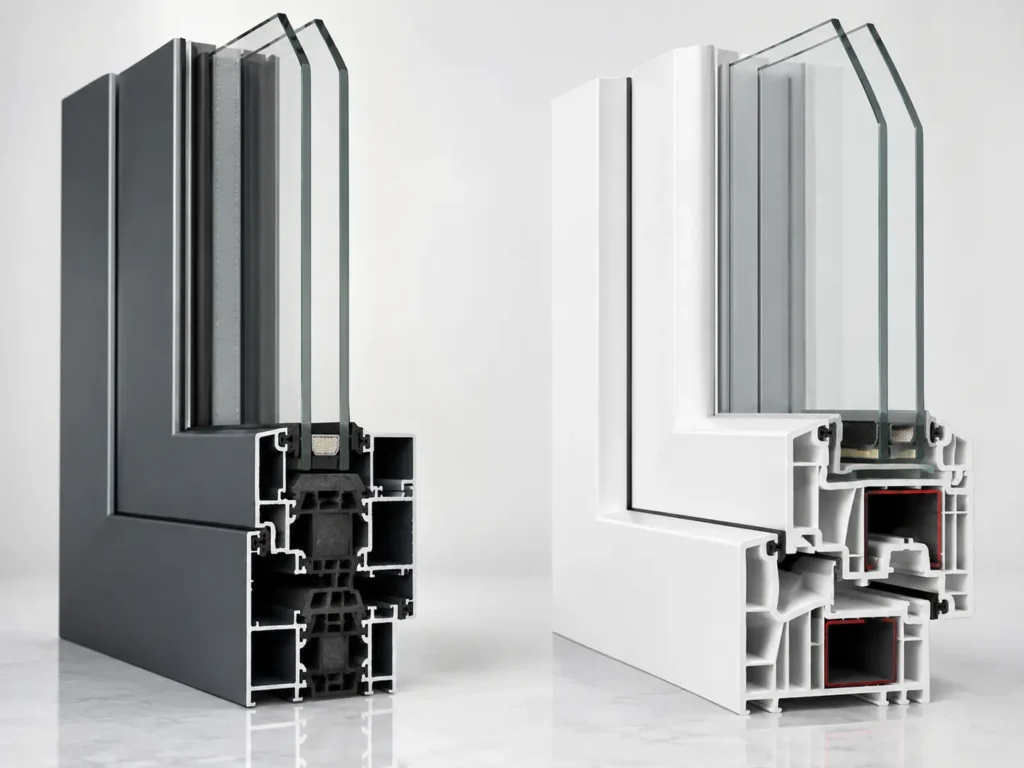
Thermal break aluminum windows are often selected for commercial and high-end residential projects because they offer strength, durability, design flexibility, and improved energy performance compared with non-thermal-break aluminum.
A thermal break system uses an insulating barrier between the interior and exterior aluminum profiles. This helps reduce heat transfer through the frame.
Thermal break aluminum is especially useful for:
- Hotels
- Apartments
- Office buildings
- Luxury villas
- Large sliding doors
- Curtain wall or window wall systems
- Oversized glass openings
- Modern minimalist architecture
Although the upfront cost is higher than basic aluminum or many uPVC systems, the ROI can come from:
- Longer service life
- Better structural performance
- More stable large-size systems
- Better compatibility with modern architectural design
- Improved energy performance
- Reduced maintenance compared with some alternatives
- Higher perceived property value
For developers, ROI is not only about product cost. It is also about long-term performance, fewer callbacks, better tenant satisfaction, and stronger market positioning.
uPVC Windows Cost-Efficiency and Limitations
uPVC windows are often attractive because of their cost efficiency and insulation performance. They are widely used in residential buildings and can be a strong option for certain apartment, townhouse, or budget-sensitive projects.
Advantages of uPVC include:
- Competitive price
- Good thermal insulation
- Low maintenance
- Corrosion resistance
- Suitable for many residential applications
However, uPVC may have limitations for some US commercial projects:
- Less structural strength for very large openings
- Design limitations for ultra-slim profiles
- Possible color and finish limitations
- Thermal expansion considerations
- May not match high-end commercial aesthetics
- May require careful verification for specific code or structural requirements
uPVC can be a smart choice when the project prioritizes budget, insulation, and standard window sizes. But for large openings, luxury projects, or commercial buildings with high structural demands, thermal break aluminum is often the stronger option.
Aluminum vs. uPVC Windows Commercial Cost Comparison
| Factor | Thermal Break Aluminum Windows | uPVC Windows |
|---|---|---|
| Initial cost | Medium to high | Low to medium |
| Structural strength | Strong | Moderate |
| Large opening suitability | Excellent | Limited depending on system |
| Thermal performance | Good with thermal break | Good |
| Design flexibility | Excellent | Moderate |
| Frame slimness | Strong advantage | Usually thicker |
| Color and finish options | Powder coating, anodizing, wood grain | Usually more limited |
| Commercial project fit | Strong | Project-dependent |
| Luxury project fit | Strong | Limited |
| Maintenance | Low | Low |
| Typical ROI logic | Durability, aesthetics, performance | Budget efficiency, insulation |
The best material depends on the project. A hotel façade, villa sliding door, and budget apartment window may each require a different solution.
That is why George Homes recommends matching the window system to the building type, local climate, design intent, performance requirements, and budget target before quoting.
6. When Importing Windows from China Makes Sense — and When It Doesn’t
Importing windows from China is not the right answer for every buyer.
It works best when the project has enough scale, planning time, and technical clarity.
Best-Fit Project Types
Importing from China usually makes sense for:
- Apartment developments
- Hotel projects
- Commercial buildings
- Student housing
- Senior living facilities
- Luxury villa projects
- Mixed-use developments
- Resort projects
- Multi-building communities
- Projects needing custom aluminum windows and doors
These projects often require large quantities, repeated sizes, coordinated specifications, and strong cost control. That is where factory-direct production and full-container shipping can create meaningful savings.
Projects Where Local Sourcing May Be Better
Local sourcing may be better for:
- Very small replacement orders
- Emergency repair jobs
- Projects with no planning time
- One or two window units
- Homeowners needing immediate local installation
- Projects where local warranty service is the top priority
- Jobs with unclear dimensions or changing designs
The main advantage of importing is not speed. It is cost control, customization, and supply chain efficiency at scale.
Importing from China Decision Matrix
| Project Situation | Importing from China? | Reason |
|---|---|---|
| Large apartment project | Yes | Bulk pricing and repeated sizes improve cost efficiency |
| Hotel or resort project | Yes | Custom design and full-package procurement can reduce total cost |
| Luxury villa development | Yes | High customization and premium finishes are available |
| Small residential replacement | Usually no | Freight and handling may reduce savings |
| Urgent repair job | Usually no | Local inventory is faster |
| Custom aluminum window system | Yes | Factory-direct production supports customization |
| Florida high-wind project | Maybe | Compliance and product approval must be verified first |
| One-stop building material procurement | Yes | Windows can ship with other construction materials |
A good sourcing decision should consider both the product package and the project schedule.
7. Bulk Buy Commercial Windows Pricing: Where Real Savings Come From
The biggest savings in importing windows from China usually come from scale.
A single window order may not justify international procurement. But a full project package can.
MOQ, Volume Discounts, and Production Efficiency
Factories become more efficient when orders are larger and specifications are repeated. Larger orders can reduce cost through:
- Bulk aluminum profile purchasing
- More efficient glass procurement
- Repeated fabrication setup
- Shared tooling or mold cost
- More efficient hardware purchasing
- Better container utilization
- Lower per-unit packaging and management cost
This is why bulk buy commercial windows pricing can be much more attractive than small-batch purchasing.
The more consistent the window schedule, the easier it is to optimize production.
Full-Container Purchasing and Unit-Cost Reduction
Container utilization is a major factor in landed cost.
If a buyer ships a half-empty container, the freight cost per window becomes higher. If the container is fully optimized, the freight cost per unit becomes lower.
A professional supplier should help buyers plan:
- Window size grouping
- Packaging dimensions
- Loading sequence
- Container mix
- Job-site delivery schedule
- Labeling by floor, building, unit, or opening number
This is especially useful for hotels, apartments, and multi-building projects where installation teams need materials organized clearly.
Consolidating Windows with Other Building Materials
One major advantage of working with George Homes is the ability to consolidate windows with other building material categories.
Instead of sourcing windows from one factory, tiles from another, sanitary ware from another, and cabinets from another, buyers can coordinate multiple categories through one supply chain.
George Homes can support project packages including:
- Tile
- Sanitary
- Kitchen & Wardrobe
- Doors
- Windows
- Aluminum systems
- Bathroom vanities
- Custom cabinetry
- Interior finishes
This creates several benefits:
| Benefit | Why It Helps B2B Buyers |
|---|---|
| Better container utilization | Reduces wasted shipping space |
| Fewer supplier contacts | Saves management time |
| More consistent project coordination | Easier communication and schedule control |
| Stronger budget planning | Multiple categories can be quoted together |
| Better documentation flow | Project manager coordinates drawings, specs, and packing |
| Lower procurement complexity | One partner supports multiple material packages |
For builders and developers, this is not just product sourcing. It is supply chain simplification.
The George Homes One-Stop Procurement Advantage
George Homes is positioned as more than a window supplier.
For US builders, developers, and project managers, George Homes provides One-Stop Building Project Solutions that help coordinate multiple material categories from China to the project destination.
This model is especially useful when buyers want:
- Factory-direct pricing
- Custom product options
- Bulk order coordination
- Export-grade packaging
- Project documentation support
- Container loading optimization
- Cross-category procurement
- A single communication channel
Instead of managing multiple factories, buyers can work through one organized project process.
8. Risk Management: How to Avoid Costly Import Mistakes
Importing windows can save money, but only if the process is managed correctly.
The most common mistakes happen before production starts.
Sample Approval and Shop Drawing Confirmation
Before mass production, buyers should confirm:
- Window schedule
- Rough opening dimensions
- Final product dimensions
- Frame depth
- Opening direction
- Glass specification
- Hardware brand or grade
- Color and finish
- Screen requirements
- Drainage details
- Installation method
- Mullion and transom layout
- Quantity by size
Shop drawings are critical. A small misunderstanding in opening direction, frame depth, or glass type can become expensive when repeated across hundreds of units.
For custom projects, George Homes can help organize technical confirmation before production so that the buyer, architect, contractor, and factory are aligned.
Factory QC and Pre-Shipment Inspection
Quality control should happen throughout the order, not only after the container arrives.
Recommended QC steps include:
| Stage | QC Focus |
|---|---|
| Before production | Confirm drawings, samples, color, glass, hardware |
| During production | Check profile cutting, corner assembly, drainage, surface finish |
| Glass assembly | Confirm Low-E position, spacer, thickness, lamination or tempering |
| Hardware installation | Check locks, hinges, rollers, handles, opening function |
| Final inspection | Check dimensions, appearance, operation, labeling |
| Packing inspection | Confirm protection, crate strength, marks, loading plan |
A pre-shipment inspection gives buyers more control before the goods leave China.
Once the container arrives in the US, correcting production mistakes becomes much more difficult and expensive.
Packaging, Labeling, and Job-Site Coordination
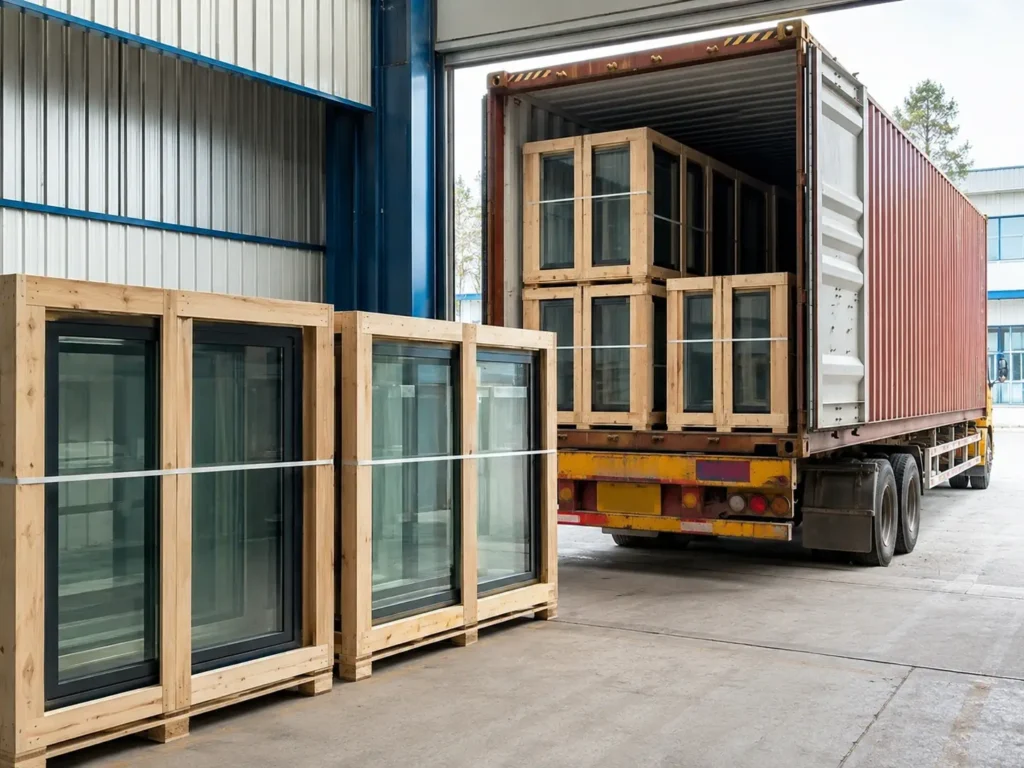
Windows are fragile, heavy, and often custom-sized. Good packaging is not optional.
Export packaging should protect against:
- Glass breakage
- Frame scratches
- Corner damage
- Moisture exposure
- Hardware loss
- Mixed-up sizes
- Loading pressure
- Job-site handling damage
Labeling is also important. Each crate should be easy to identify by project, building, floor, unit, room, or opening number.
For large projects, organized packing can save labor time during installation.
A low-cost supplier that ignores packaging may create hidden costs through job-site confusion, breakage, and delays.
Working with One Dedicated Project Manager Instead of Multiple Factories
One of the biggest challenges in sourcing from China is communication.
A US builder may need to coordinate:
- Window factory
- Door factory
- Tile supplier
- Sanitary ware supplier
- Cabinet factory
- Freight forwarder
- Customs broker
- Quality inspector
- Packaging team
- Logistics provider
Without a single point of coordination, small mistakes can multiply quickly.
George Homes solves this problem by providing a Dedicated Project Manager to help coordinate the sourcing process, product details, timeline, documentation, and communication.
For B2B buyers, this can reduce management time and lower the risk of miscommunication.
FAQ
Conclusion: Is Importing Windows from China Worth It?
Importing windows from China to the US can be worth it, especially for builders, developers, and project managers working on large, planned, specification-driven projects.
The biggest advantages include:
- Factory-direct pricing
- Custom aluminum and thermal break systems
- Bulk buy commercial windows pricing
- Flexible design options
- Multi-category procurement
- Container optimization
- Stronger project-level cost control
But the lowest factory quote is not the same as the lowest project cost.
To make importing successful, buyers need to manage:
- Landed cost
- Duties and tariffs
- Freight and inland logistics
- NFRC and AAMA / FGIA-related requirements
- Florida or high-wind-zone approval needs
- Shop drawings
- Quality control
- Packaging and labeling
- Job-site delivery coordination
For the right project, George Homes helps simplify this process through factory-direct sourcing, technical coordination, quality control support, and One-Stop Building Project Solutions across windows, doors, Tile, Sanitary, and Kitchen & Wardrobe systems.
If you are planning a hotel, apartment, villa, commercial building, or multi-unit development, George Homes can help you compare local procurement with China factory-direct sourcing and build a clearer landed cost estimate before you commit.
Ready to reduce procurement complexity and control your project budget?
Contact George Homes to request a customized window package quotation, landed cost estimate, and one-stop building materials solution for your next US project.