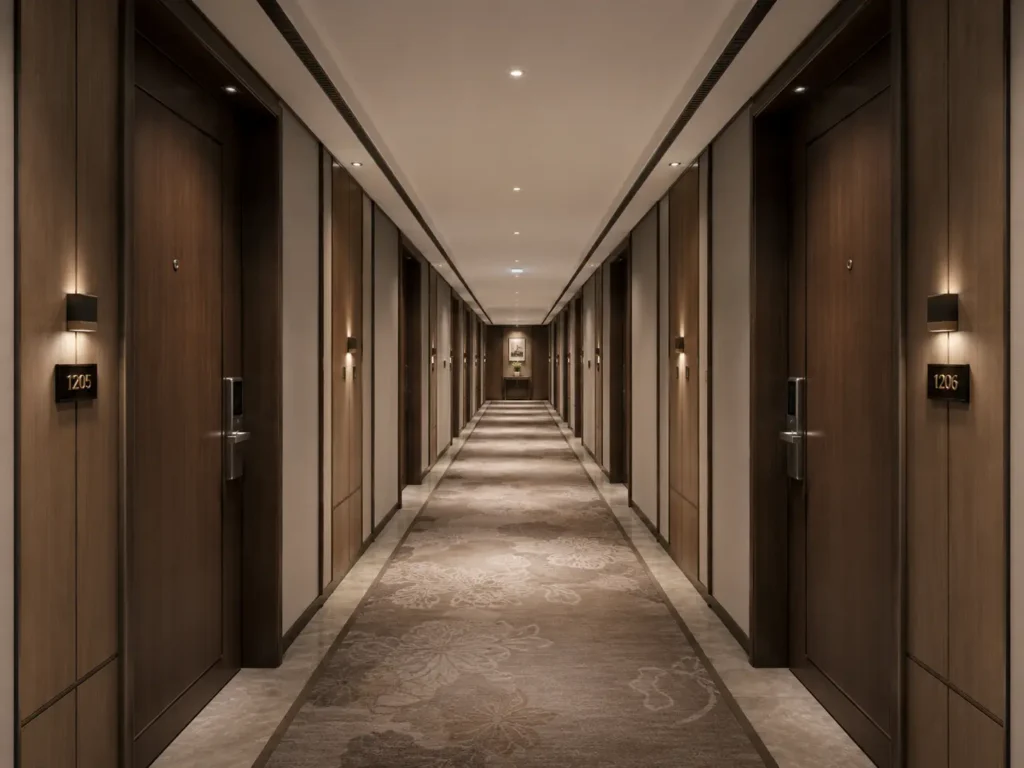
When managing a hospitality development, every architectural detail directly impacts guest satisfaction, operational efficiency, and regulatory compliance. Among these details, choosing the right doors for hotel projects is one of the most critical yet complex tasks.
Hotel doors are not merely entryways; they are sophisticated components that must balance stringent fire safety codes, high-performance acoustic insulation, heavy-duty durability, and seamless aesthetic appeal. For project managers, general contractors, and developers, making the wrong choice can lead to inspection failures, costly retrofits, and negative guest reviews. This comprehensive guide outlines the vital factors you must consider to select the perfect doors for your next hotel project.
1. Strict Fire Safety and Building Code Compliance
In commercial hospitality construction, life safety is the absolute priority. Local and international building authorities enforce strict fire codes that dictate exactly where and what type of fire-rated doors must be installed.
Understanding Fire Ratings (20, 45, 60, and 90-Minute Doors)
Fire doors are classified by the duration they can withstand exposure to fire and smoke without failing.
- 20-Minute Doors: Typically required for standard hotel guestroom entry doors leading to interior corridors.
- 45 to 60-Minute Doors: Often mandated for service rooms, vertical shafts, or corridors with higher risk profiles.
- 90-Minute (or higher) Doors: Reserved for major fire barriers, stairwells, and boiler or mechanical rooms.
Choosing the correct fire rating ensures that in the event of an emergency, fire and toxic gases are contained, allowing guests ample time to evacuate safely.
International Certifications to Look For (UL, CE)
When sourcing doors globally, verifying third-party testing and certifications is essential. Ensure your manufacturer provides doors compliant with:
- UL 10C / NFPA 252: The standard fire test safety standards widely recognized in North America and global markets.
- BS 476 / EN 1634 (CE Marking): The standard protocols for European and British markets.
Working with a supplier who understands these regulations prevents custom-ordered doors from being rejected during final building inspections.
2. Acoustic Performance (STC Ratings) for Guest Privacy
A hotel’s reputation hinges heavily on sleep quality. Hallway chatter, rolling luggage, and slamming adjacent doors are top sources of guest complaints. Therefore, maximizing acoustic privacy is paramount when selecting doors for hotel projects.
Acoustic performance is measured by the Sound Transmission Class (STC) rating. The higher the STC rating, the more sound the door blocks.
- STC 20–25: Poor insulation; low speech can be understood easily.
- STC 30–35: Standard performance; loud speech can be heard but not understood.
- STC 40–45+: Premium hospitality performance; loud sounds are faint or entirely muted.
To achieve an STC rating of 40 or higher, guestroom doors must feature a solid core construction (such as particleboard, mineral core, or solid timber) rather than a hollow core. Additionally, the door assembly must include heavy-duty perimeter drop-seals, acoustic gaskets, and tightly fitted thresholds to prevent sound leaks through gaps.
3. Durability and Material Selection for High-Traffic Areas
Hotel doors endure immense wear and tear. They are constantly subjected to luggage bumps, housekeeping carts, forceful closures, and heavy daily traffic. Choosing the right material ensures longevity and minimizes ongoing maintenance costs.
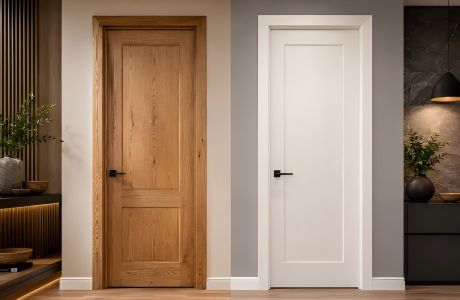
- Solid Wood: Offers unmatched luxury, warmth, and high aesthetic value. Ideal for luxury boutique hotels or 5-star presidential suites, though it requires precise climate control to prevent warping.
- Solid Core MDF / HPL (High-Pressure Laminate): The industry standard for modern hotel guestrooms. They provide excellent fire and acoustic properties, resist scratching, are highly stable against humidity changes, and offer cost-effective uniformity.
- Hollow Metal / Steel Doors: Best suited for back-of-house areas, service corridors, stairwells, and exterior exits where maximum security and rugged durability are required.
When evaluating durability, pay close attention to the hardware prepping. Hinges, locks, and closers must be commercial-grade (Grade 1) to handle hundreds of cycles per day without sagging or failing.
4. Seamless Aesthetic Integration with Hotel Design
While functionality and safety are non-negotiable, doors also serve as a visual introduction to the guest experience. The door finish, texture, and profile must seamlessly match the hotel’s overarching design concept—whether it is ultra-modern minimalism, classic luxury, or mid-century industrial.
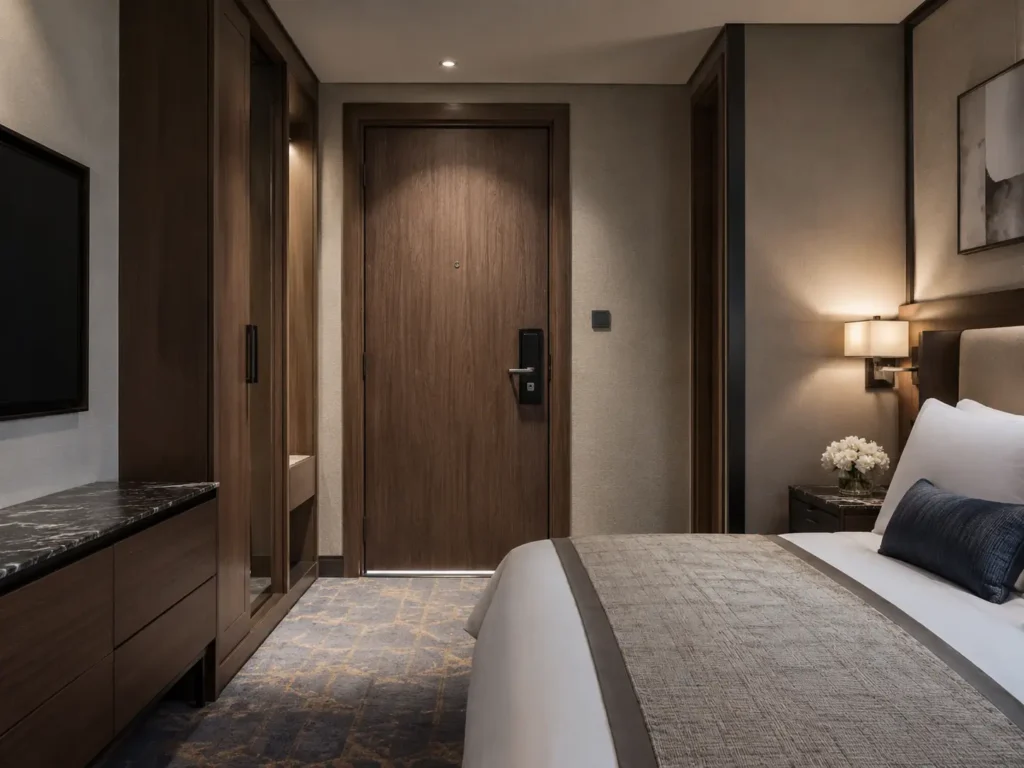
To create a truly cohesive interior atmosphere, designers must coordinate the door veneers or paint finishes with other major elements in the room. For instance, the wood grain of the guestroom entry door should harmoniously complement the bespoke Furniture Collection inside the suite. Furthermore, transition thresholds beneath the door must align perfectly with the selected Flooring & Staircase design to eliminate awkward visual breaks. Custom manufacturing allows you to dictate matching architrave profiles, flush designs, or integrated transom panels to achieve a flawless architectural flow.
5. Smart Security and Access Control Compatibility
The modern hotel door is an active part of the property’s technology ecosystem. Standard mechanical keys are obsolete; today’s hospitality sector relies heavily on electronic access control systems, including RFID cards, PIN pads, and Bluetooth-enabled mobile keys.
Integrating these smart locking systems requires careful planning during the manufacturing phase. Hotel doors must be precisely CNC-machined at the factory to accommodate:
- Specific mortise lock bodies and locksets.
- Internal raceways (conduits) for hardwired electronic locks.
- Electronic power transfers (EPT) or battery compartments.
Attempting to cut or modify fire-rated doors on-site to fit smart locks can void their fire certification and ruin the door’s structural integrity. Always provide your door manufacturer with exact hardware templates before production begins.
6. The Advantage of a One-Stop Building Materials Solution
Procuring individual components from fragmented suppliers is one of the biggest bottlenecks for overseas project managers. Managing different factories for doors, another for frames, and another for smart locks often results in mismatched dimensions, delayed timelines, and finger-pointing when parts do not fit on-site.
Partnering with a comprehensive supplier like George Homes solves these supply chain headaches. By integrating your Doors & Windows manufacturing under one roof, you ensure absolute consistency in dimensions, finishes, and quality control. Furthermore, a consolidated supplier allows you to coordinate these openings alongside your interior Tile layouts and luxury Sanitary fixtures, optimizing your entire container shipping volume and reducing overall freight costs.
With a Dedicated Project Manager overseeing your order, you receive end-to-end support—from initial blueprint review and fire code verification to custom manufacturing, lockset preparation, and safe delivery directly to your job site.
Frequently Asked Questions (FAQs)
In almost all international building codes, guestroom entry doors opening into public corridors must be fire-rated (typically a minimum of 20 minutes) to create a safe barrier between the sleeping area and the evacuation route. Interconnecting doors between adjoining rooms also require fire ratings.
For a 4-star or 5-star guest experience, an STC rating of 40 to 45 is highly recommended for entry doors. This successfully blocks the majority of corridor noise, ensuring undisturbed sleep for your guests.
Standard B2B production lead times typically range from 30 to 45 days, depending on the volume and customization complexity (such as specific fire cores or custom veneers). Partnering with a streamlined factory allows for synchronized production schedules that match your project’s construction timeline.
Elevate Your Next Project with George Homes
Stop juggling dozens of independent factories and risking mismatched dimensions or delayed compliance checks. At George Homes, we provide a streamlined, high-efficiency procurement experience engineered specifically for commercial builders, developers, and general contractors worldwide.
Whether you need certified fire-rated entryways, premium acoustic doors, or a complete interior fit-out, our team is ready to deliver. Contact a Dedicated Project Manager via WhatsApp or email today to submit your blueprints, request a custom B2B quote, and unlock your comprehensive project consultation.